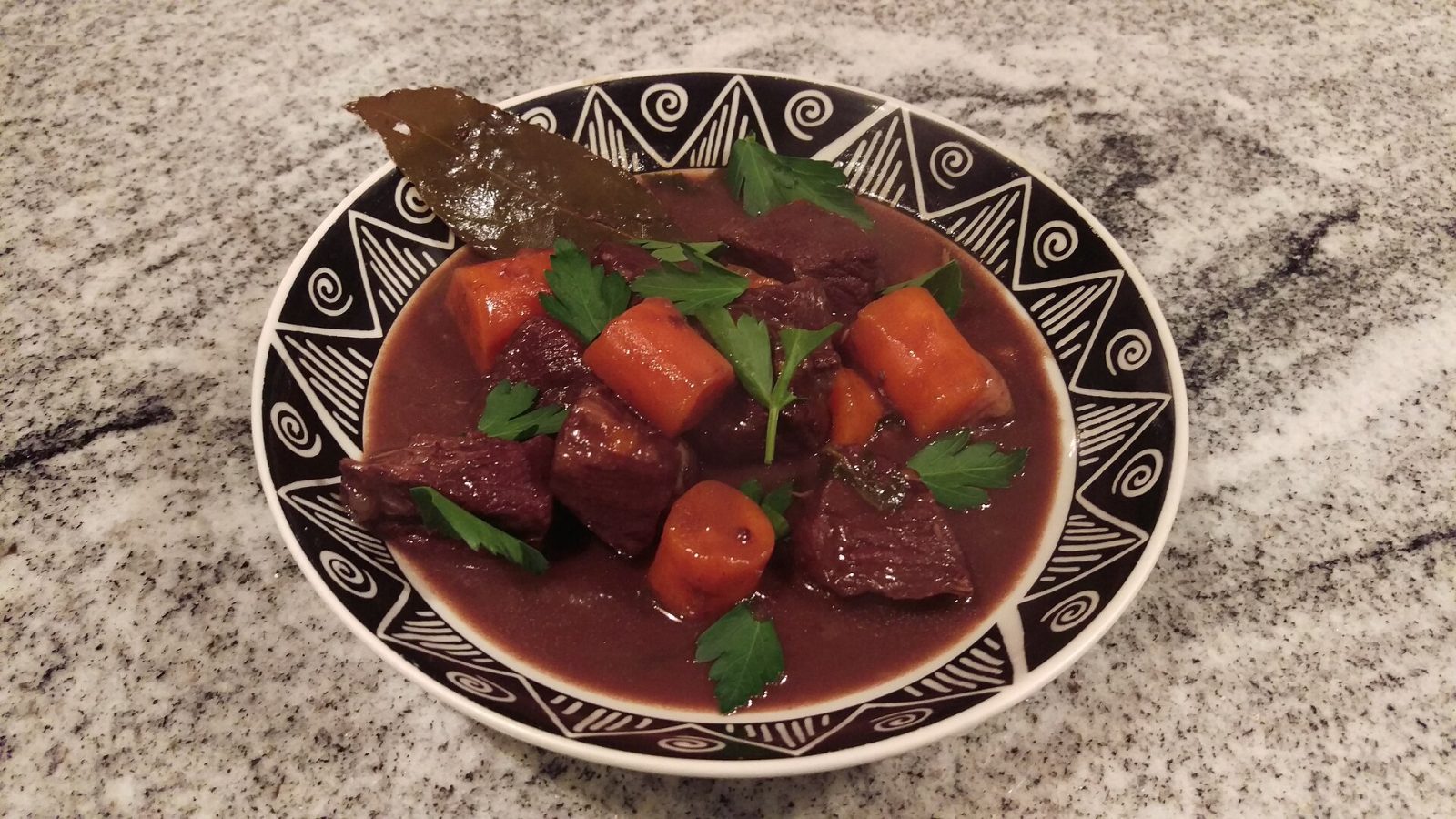
Beef Burgundy (Bœuf Bourguignon)
Declassified 22 August 2026
Threat assessment
- 1 No contact Nobody is in danger. Least of all the locals.
- 2 Light resistance A warmth. You mention it. Nobody responds.
- 3 Engaged You are sweating. No one else at the table is sweating.
- 4 Taking fire You have stopped talking. A child has taken your portion.
- 5 Operative down Extraction required. Locals describe this one as "not spicy".
Bœuf bourguignon is the archetypal French brown braise: chuck beef marinated in red Burgundy, seared in lardon fat, dusted with flour and toasted in a hot oven, then simmered for three hours in the wine with stock and aromatics. What separates a great one from a brown stew is discipline about the two halves — the braising liquid is strained and reduced to a glossy, deeply savoury sauce, while the garniture à la bourguignonne of glazed pearl onions, hard-sautéed mushrooms and blanched lardons is cooked entirely separately and folded in at the very end so each element still tastes of itself. Use a wine you would drink, because the sauce is mostly wine and there is nowhere for a bad bottle to hide. It is better on the second day, and Burgundian cooks make it that way on purpose. Photo: Slayschips (CC BY-SA 4.0), via Wikimedia Commons.
// SUPPLY LIST
SCALE:
| AMT | UNIT | ITEM |
|---|---|---|
| 1.6 | kg | Beef chuck or shoulder clod (paleron/macreuse), hard gristle trimmed, cut into 5 cm cubes |
| 750 | ml | Red Burgundy or other dry Pinot Noir, good enough to drink |
| 250 | g | Onions, peeled and roughly chopped, for the marinade |
| 250 | g | Carrots, peeled and cut into 2 cm lengths |
| 4 | clove | Garlic, peeled and lightly crushed |
| 3 | sprig | Thyme sprigs, for the bouquet garni |
| 2 | Bay leaves, for the bouquet garni | |
| 6 | Parsley stalks, tied with the thyme and bay inside a leek green | |
| 1 | tsp | Black peppercorns, whole, lightly cracked |
| 200 | g | Smoked pork belly (poitrine fumée) or unsliced thick smoked streaky bacon, rind off, cut into lardons about 1 x 1 x 4 cm |
| 2 | tbsp | Beef dripping or neutral oil, for rendering and searing |
| Fine sea salt | ||
| 50 | ml | Marc de Bourgogne or Cognac |
| 30 | g | Plain flour |
| 1 | tbsp | Tomato purée (double concentrate) |
| 500 | ml | Brown beef or veal stock, unsalted |
| 300 | g | Pearl or grelot onions (oignons grelots), roots trimmed, skins left on until blanched |
| 60 | g | Unsalted butter |
| 1 | tsp | Caster sugar |
| 300 | g | Button mushrooms (champignons de Paris), wiped, halved or quartered to walnut size |
| 1 | tbsp | Sunflower or grapeseed oil, for the mushrooms |
| 2 | tbsp | Flat-leaf parsley, finely chopped |
| Black pepper, freshly ground |
// OPERATIONS
- 1 Put the beef in a non-reactive bowl or a large zip-lock bag (glass, ceramic, stainless steel or food-grade plastic — never bare aluminium or uncoated cast iron, which the wine's acid strips and turns metallic) with the chopped onions, carrots, garlic, bouquet garni and cracked peppercorns, and pour over the whole bottle of wine. One bottle will not submerge 1.6 kg of meat plus half a kilo of vegetables, so use a container the beef only just fits into, or press the air out of the bag so the wine is forced against every surface, then refrigerate 12-24 hours and turn the whole lot over three or four times. Add no salt now: the lardons are salty and the sauce gets reduced hard at the end, and salt left this long in a wet marinade cures the surface of the meat and gives the finished braise a faintly hammy edge.
- 2 Set a colander over a bowl and drain, keeping the wine. Lift the bouquet garni out and set it aside on its own — it goes into the braise later and must not end up in the frying pan — then put the vegetables in one dish and the beef in another. Spread the beef on a tray lined with kitchen paper, blot every cube dry on all faces and leave it uncovered at room temperature for 20 minutes, until the surfaces look matt rather than wet and glossy; wine-wet meat steams instead of searing, and you get grey cubes, no fond and a thin sour sauce that no amount of reduction will fix.
- 3 Bring the reserved wine to the boil in a saucepan over high heat, boil it hard for 5 minutes and skim off the grey-purple foam as it rises, then turn it down to a bare simmer and keep it hot. You want a clear, wine-smelling liquid with no scum left on the surface — the coagulated protein and lees you are skimming off are exactly what would otherwise cloud the finished sauce and leave it tasting raw and tannic.
- 4 Put the lardons in a small pan, cover with cold water, bring to the boil, simmer 5 minutes, then drain and pat dry. Render them with a teaspoon of the dripping in a 26-28 cm cast-iron casserole (5-6 litre, with a lid) over medium heat for 8-10 minutes, until the fat has run clear and the lardons are golden but still supple rather than brittle, then lift them out with a slotted spoon and reserve for the garnish; heat the oven to 230°C / 450°F now so it is fully up to temperature when you need it. Blanching is not fussiness — supermarket smoked bacon is salty and aggressively smoky, and unblanched it will bully the wine right out of the sauce. Skip it only if you are using unsmoked, lightly salted pancetta.
- 5 Raise the heat to medium-high and add just enough dripping or oil to give the base a thin, shimmering film, a millimetre at most, since the rendered lardon fat is already in there; a deep pool of fat shallow-fries the beef instead of searing it and leaves the sauce greasy later. Season the dried beef with about 1.5 teaspoons of the fine salt, then brown it in 3 or 4 batches, 6-8 minutes a batch, turning so at least three faces of every cube take a deep chestnut crust, and transfer each batch to a tray. Leave a finger's width between the cubes: crowding drops the pan temperature, the meat releases its juices and boils, and you lose the fond that carries the whole sauce.
- 6 Pour off all but about 2 tablespoons of the fat, then add the drained marinade vegetables and cook over medium-high heat for 5-6 minutes, stirring, until their surface moisture has gone and the onion edges catch and go brown. Pour the fat off first and do not skip it — vegetables tipped into a pool of fat stew and stay pale, and pale vegetables give a flat, thin-tasting sauce. Pull the pan off the heat, add the marc or Cognac, scrape the base hard with a wooden spoon to lift the fond, then return it to the heat and let it bubble for about a minute until the raw spirit smell has burned off.
- 7 Return the beef and any juices from the tray to the casserole, sprinkle the flour evenly over the top and toss until every cube is dusted. Put the uncovered casserole into the 230°C / 450°F oven for 4 minutes, stir well, and give it 4 minutes more: the flour should look sandy and dry and smell of biscuit, not raw paste, because flour that is still pasty at this point will taste floury however long the dish braises. Take the casserole out and drop the oven to 150°C / 300°F.
- 8 Stir in the tomato purée, then pour in the hot skimmed wine and add enough of the stock, about 450-500 ml, to bring the liquid just short of level with the top of the meat — barely covered, not swimming, or you will spend an extra hour boiling the sauce back down and the wine flavour will go flabby. Tuck in the reserved bouquet garni and bring it to a bare simmer on the hob, a lazy bubble every second or two and never a rolling boil, which shreds the collagen too fast and leaves the meat stringy and the sauce cloudy, then put the lid on and transfer it to the oven.
- 9 Braise at 150°C / 300°F for 2 hours 45 minutes to 3 hours 15 minutes, starting to check at 2 hours 30. It is ready when the tip of a paring knife slides into a cube and withdraws with no resistance at all, and a cube lifted on a spoon holds its shape for a moment before slumping; if it falls apart into threads on the spoon you have gone about 20 minutes too far, which is exactly why you start testing early.
- 10 While it braises, glaze the small onions à brun: drop them into boiling water for 60 seconds, drain and slip off the skins, then set them in a single layer in a 24 cm sauté pan with 30 g of the butter, the sugar, a pinch of salt and 150 ml water. Cover with a parchment cartouche and cook over medium-low heat for 20-25 minutes, until the water has gone and a knife tip meets no resistance, then uncover and swirl the pan over medium heat for 4-5 minutes until the butter and sugar caramelise to an even chestnut glaze. Swirl rather than stir, and take them off the moment they are mahogany — caramel goes from glaze to bitter in under a minute.
- 11 Sauté the mushrooms in a 26-28 cm frying pan over high heat in the tablespoon of oil, spread in one uncrowded layer: leave them untouched for 2 minutes, then toss every 30 seconds for 6-8 minutes in total, until they have thrown their water, it has fully evaporated and the cut faces are golden brown. Add the remaining 30 g butter only for the last minute and salt them only at the very end — butter in from the start blackens over this much heat and turns the pan bitter, and salt added early makes them weep, stew in their own liquid and go grey and squeaky.
- 12 Lift the beef out with a slotted spoon into a bowl, then strain the braising liquid through a fine sieve into a wide saucepan, pressing the vegetables only gently to release their juice before discarding them and the bouquet garni; forcing the pulp through the sieve makes the sauce gritty and muddy. Skim the fat off the surface with a ladle, then simmer briskly for 15-25 minutes, stirring the base now and then because the flour in it will catch and scorch, until you have about 750 ml of sauce that coats the back of a spoon and holds a clean line when you draw a finger through it. Season with salt and plenty of freshly ground black pepper and taste properly here — this is the only point at which the seasoning of the whole dish is decided.
- 13 Return the beef, lardons, glazed onions and mushrooms to the casserole, pour the sauce over and reheat very gently for 10 minutes at just below a simmer so nothing breaks up, then take it off the heat and let it rest, covered, for 20-30 minutes so the sauce settles back into the meat. Better still, cool it and refrigerate it overnight and reheat it slowly the next day, which is how it is usually eaten in Burgundy and is unarguably better. Scatter with the chopped parsley and serve with steamed or boiled potatoes rolled in butter, or buttered fresh noodles, plus bread for the sauce and the rest of the same Pinot Noir in the glass.