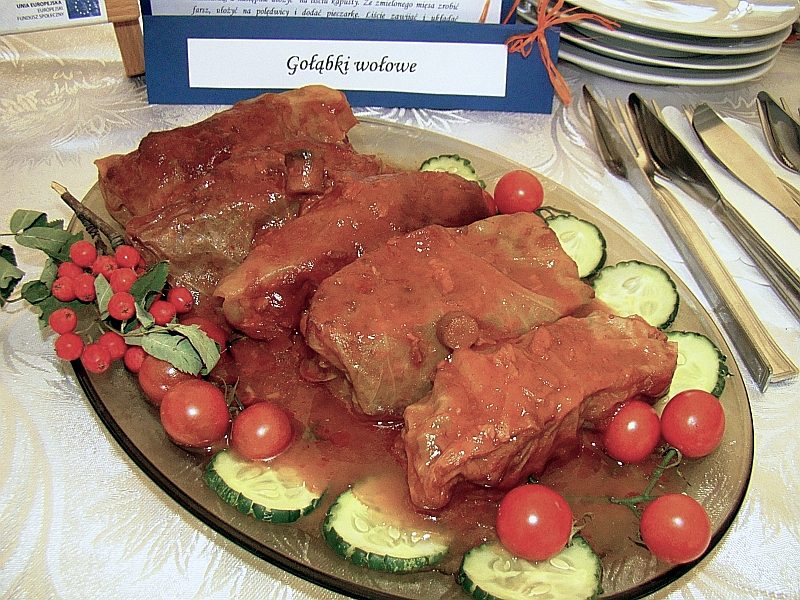
Gołąbki (Polish Stuffed Cabbage Rolls)
Declassified 22 August 2026
Threat assessment
- 1 No contact Nobody is in danger. Least of all the locals.
- 2 Light resistance A warmth. You mention it. Nobody responds.
- 3 Engaged You are sweating. No one else at the table is sweating.
- 4 Taking fire You have stopped talking. A child has taken your portion.
- 5 Operative down Extraction required. Locals describe this one as "not spicy".
Gołąbki are blanched cabbage leaves wrapped around minced pork and rice, packed tight into a bacon-lined pot and braised slowly under stock and tomato sauce until the leaves turn silky and the central rib gives with no resistance. They are eaten across Poland, but the eastern regions — Podlasie above all — make the version worth copying: pearl barley or buckwheat as readily as rice, dried forest mushrooms in the filling, smoked bacon under the rolls. A good one holds together when you cut it, tastes of marjoram and sweet braised cabbage rather than boiled greens, and sits in its sauce rather than swimming in it. Make them a day ahead if you can, because the filling firms up overnight and the sauce works into the leaves, which is why most Polish cooks think the second day is the better one. Photo: Silar (CC BY-SA 3.0), via Wikimedia Commons.
// SUPPLY LIST
SCALE:
| AMT | UNIT | ITEM |
|---|---|---|
| 2.2 | kg | White cabbage, one large firm head, core cut out in a deep cone |
| 3 | tbsp | Coarse salt, for the blanching water and the rice water |
| 180 | g | White rice, short or medium grain, rinsed until the water runs clear (or pearl barley or buckwheat for the Podlasie version) |
| 15 | g | Dried porcini or other dried forest mushrooms |
| 150 | g | Smoked streaky bacon, rind removed, cut into 1 cm lardons |
| 70 | g | Unsalted butter, divided: 20 g for the onions, 50 g for the zasmażka |
| 300 | g | Onions, finely diced |
| 3 | clove | Garlic, finely grated |
| 1 | kg | Minced pork shoulder, around 20 percent fat, coarsely minced |
| 1 | Egg, large, lightly beaten | |
| 15 | g | Fine sea salt, for the filling |
| 2 | tsp | Black pepper, coarsely ground |
| 1 | tbsp | Dried marjoram |
| 2 | Bay leaves | |
| 6 | Allspice berries, whole | |
| 1 | l | Chicken or pork stock, hot |
| 50 | g | Plain flour, for the zasmażka roux |
| 500 | ml | Passata or smooth tomato purée |
| 2 | tsp | Caster sugar |
| Dill, fresh, finely chopped, to finish | ||
| Soured cream, 18 percent, to serve |
// OPERATIONS
- 1 Cut a deep cone around the core of the cabbage with a paring knife and lift it out. Bring at least 6 litres of water to a rolling boil in a tall stockpot with 2 tbsp of the coarse salt, lower the whole head in core-side down and simmer 4 minutes, then, holding the head steady with a carving fork pushed into the core cavity, peel away the outer leaves with tongs as they go floppy and translucent at the base. Return the head to the water for 2 to 3 minutes between each round of three or four leaves until you have 20 whole leaves plus a pile of torn and small ones — peel 20 for 16 rolls, because two or three will always crack at the rib and you do not want to be re-boiling the head with filling already mixed. Do not try to strip the head in one go: leaves pulled before they soften split along the rib and will burst in the pot. Spread the leaves on trays to cool. (Accepted Polish shortcut: freeze the head whole and un-cored for at least 24 hours, then thaw it completely in the fridge — allow a full 24 hours for a head this size, not just overnight — and the leaves pull away limp and pliable with no boiling at all. They come out wetter and a little softer than blanched leaves, so drain them well and roll slightly tighter.)
- 2 Lay each leaf rib-side up and pare the raised central rib down flush with the leaf, holding a sharp knife almost flat and shaving the wedge off in one stroke. Do not cut the rib out — a hole there leaks filling through the whole braise and you lose the roll. Set the torn and undersized leaves aside for lining and covering the pot.
- 3 Boil the rinsed rice in 500 ml water salted with the remaining 1 tbsp coarse salt for exactly 6 minutes (pearl barley or buckwheat: 15 minutes, as groats need far longer than rice to reach the same half-cooked state), drain, and spread it on a plate to cool. It must be half-cooked and still chalky in the centre: fully cooked grain collapses into paste during the braise, while raw grain pulls moisture out of the pork and leaves the rolls dry and gritty.
- 4 Cover the dried mushrooms with 200 ml just-boiled water and leave 20 minutes, until they are fully soft with no leathery core. Lift them out, squeeze them dry over the bowl, chop them finely, and reserve the soaking liquid — pour it off carefully and leave the last tablespoon of grit behind in the bowl.
- 5 Put the bacon lardons into a cold 24 cm frying pan and set it over medium heat; fry 8 to 10 minutes until the fat has run and the meat is bronzed but still soft, then lift the lardons out with a slotted spoon and reserve. Add 20 g of the butter to the bacon fat, then the diced onion, and sweat over medium-low heat for 12 to 14 minutes, stirring, until deep gold and completely collapsed, adding the garlic and chopped mushrooms for the last minute. Spread this on a plate and cool it to room temperature, about 20 minutes — warm onion starts to cook the pork on contact and the filling turns greasy and grainy.
- 6 In a large bowl combine the minced pork, cooled rice, cooled onion mixture, beaten egg, 15 g fine salt, black pepper and the marjoram rubbed hard between your palms to wake up its oil. Mix with one hand for a full 2 minutes, pressing and folding, until the mass turns tacky and clings to your fingers — an under-mixed filling crumbles the moment you cut a roll. Fry a flattened teaspoon of it in a dry pan for 90 seconds a side and taste: this is your only chance to correct the seasoning, and it should taste assertively of salt and marjoram, because the cabbage around it is bland.
- 7 Place about 100 g of filling (one ice-cream scoop) in a line across the base of each leaf just above the pared rib. Fold the rib end up over the filling, fold both sides in tight like a parcel, and roll firmly away from you to the tip, finishing seam-side down. You should get 16 to 18 rolls. Roll snug but do not compact it into a ball — the rice still has to swell, and an over-packed roll bursts its leaf in the oven.
- 8 Heat the oven to 160°C / 320°F now, so it is at temperature when the pot is ready. Line the base of a 28 cm cast-iron or heavy enamelled casserole with the reserved torn and small leaves — this layer is what stops the bottom rolls scorching — and scatter the reserved bacon lardons over them. Pack the rolls seam-down in tight concentric circles, two layers deep, tucking the bay leaves and allspice berries between them. They should sit shoulder to shoulder so they hold each other shut; a loose pot lets them unroll. Cover the top layer with a lid of overlapping cabbage leaves.
- 9 Combine the reserved mushroom liquid with the hot stock and pour it down the inside wall of the pot until it comes about two-thirds of the way up the rolls, never over them — in a 28 cm pot packed two layers deep this takes roughly 1.2 litres, but stop at two-thirds and keep any leftover stock back for the sauce. Gołąbki are steamed under sauce, not boiled in it: submerged rolls go slack, waterlogged and pale. Bring to a bare simmer on the hob, then cover with the lid and transfer to the preheated oven.
- 10 Braise for 1 hour 45 minutes. They are ready when a thin skewer slides from the top of a roll to the bottom with no resistance at the rib, the kitchen smells sweet rather than sulphurous, and a roll cut open shows swollen, distinct grains rather than paste. Do not cut this short: at the one-hour mark the pork is cooked through but the cabbage rib is still tough and the roll eats stringy.
- 11 Lift the rolls onto a warm tray. Pick the bacon lardons out of the pot base and set them aside — do not throw them out with the debris — then strain 600 ml of the braising liquid into a jug, topping up with reserved stock if you are short, and discard the spent leaves, bay and allspice. In a 20 cm saucepan melt the remaining 50 g butter over medium heat, stir in the 50 g flour and cook this zasmażka for 2 minutes until it smells of biscuits but is still blond, then whisk in the hot braising liquid one ladle at a time so no lumps form, followed by the passata and the sugar. Simmer 10 to 12 minutes, whisking often, until it thickly coats the back of a spoon and leaves a clean line when you draw a finger through it and the raw flour taste is gone; season with salt and pepper and taste for the sweet-sour balance, adding a pinch more sugar only if the tomato still bites.
- 12 Return the rolls and the reserved lardons to the pot, pour the sauce over them, put the lid back on and leave them in the switched-off oven, or over the lowest possible flame, for 20 to 30 minutes. This rest is not optional: it lets the sauce work into the leaves and firms the rolls enough to lift out whole instead of in pieces. They are excellent now and honestly better the next day — cool, refrigerate overnight and reheat covered at 150°C / 300°F for 35 to 40 minutes, until the centre of a roll is steaming hot.
- 13 Serve two or three rolls per person with a generous ladle of sauce over the top, boiled potatoes or a thick slice of rye bread, a heavy scatter of chopped dill, and a spoon of soured cream on the side, which is how they come to the table across Podlasie.