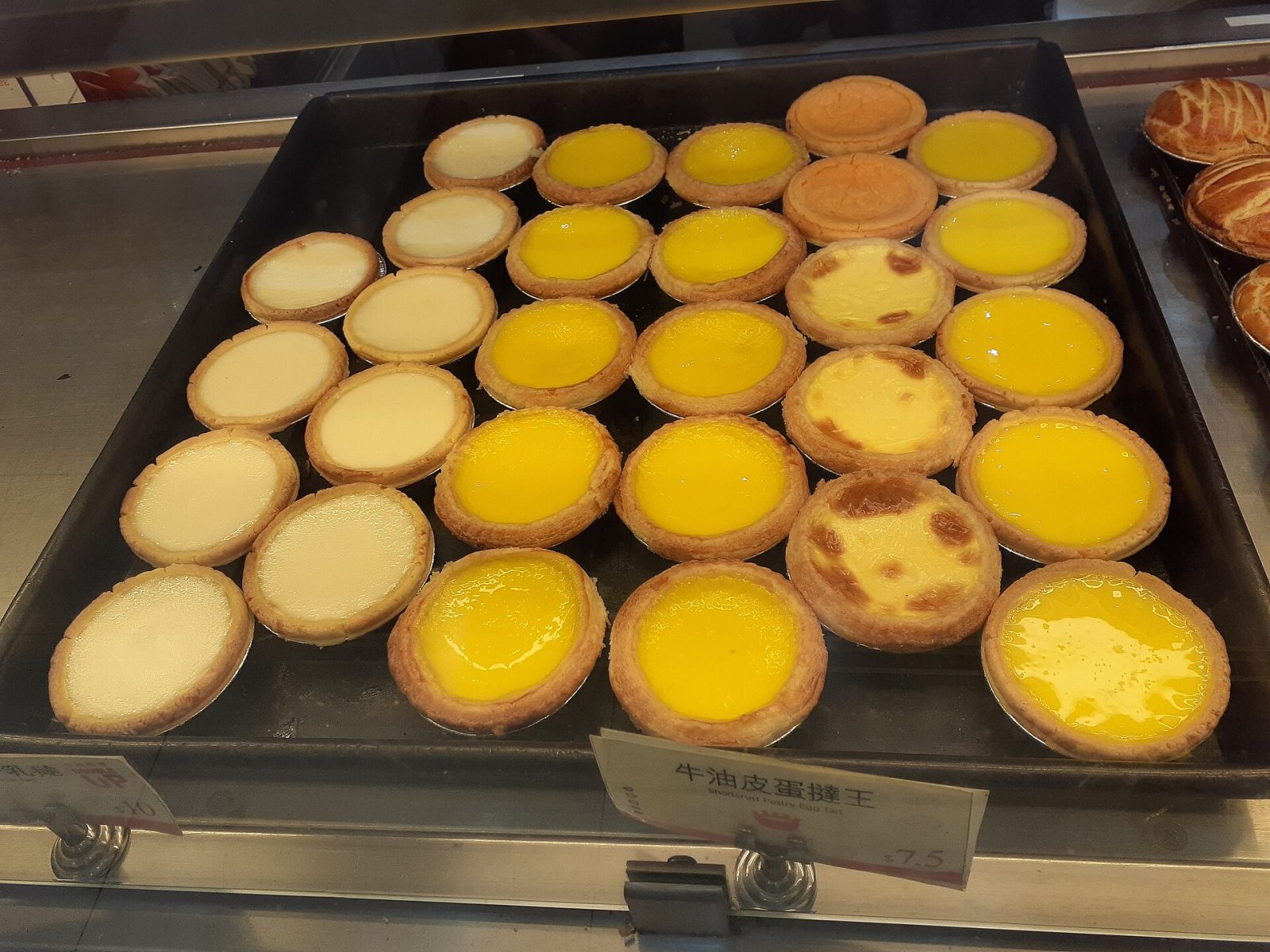
Hong Kong Egg Tarts (蛋撻)
Declassified 22 August 2026
Threat assessment
- 1 No contact Nobody is in danger. Least of all the locals.
- 2 Light resistance A warmth. You mention it. Nobody responds.
- 3 Engaged You are sweating. No one else at the table is sweating.
- 4 Taking fire You have stopped talking. A child has taken your portion.
- 5 Operative down Extraction required. Locals describe this one as "not spicy".
The Hong Kong egg tart is a small fluted tart of barely-set egg custard in a short, buttery biscuit crust, sold warm by the tray in neighbourhood bakeries and cha chaan teng. It descends from the British custard tart by way of the competing department-store bakeries of 1920s Guangzhou, crossed into Hong Kong after the Second World War and became a bakery fixture through the 1950s; it is emphatically not the Macanese pastel de nata, and the top must be glossy, even and pale gold, never blistered or caramelised. This is the 餅皮 cookie-crust version popularised by Tai Cheong, built on butter rather than the lard used in the flaky 酥皮 style, which makes it genuinely vegetarian. A good one has a shell that snaps shortly under the teeth and a custard that trembles, tastes clearly of egg and evaporated milk, and is only just sweet. Photo: LNAM Haoi (CC BY-SA 4.0), via Wikimedia Commons.
// SUPPLY LIST
SCALE:
| AMT | UNIT | ITEM |
|---|---|---|
| 115 | g | Unsalted butter, cubed, softened to cool room temperature (about 19°C/66°F — it should dent under a finger but not smear) |
| 55 | g | Icing sugar, sifted, for the pastry |
| 0.25 | tsp | Fine sea salt, for the pastry |
| 1 | Medium egg, beaten (about 48 g out of the shell), at room temperature | |
| 0.5 | tsp | Vanilla extract, for the pastry |
| 225 | g | Plain flour, about 10% protein, plus a little for dusting |
| 85 | g | Caster sugar, for the custard syrup |
| 160 | ml | Boiling water |
| 3 | Large eggs, at room temperature (about 55 g each out of the shell, roughly 165 g in total — weigh them, because a US large egg is nearly 15% lighter than a UK one and the custard sets on this ratio) | |
| 80 | ml | Full-fat evaporated milk, at room temperature (Black & White is the Hong Kong standard; not condensed milk, not fresh milk) |
| 0.25 | tsp | Vanilla extract, for the custard |
// OPERATIONS
- 1 Beat the 115 g butter with the 55 g sifted icing sugar and 1/4 tsp salt in a bowl with a wooden spoon, or in a stand mixer with the paddle on low, for 60-90 seconds — only until smooth, homogeneous and barely paler, with no grit of sugar left when you rub a smear between finger and thumb. Stop well before it looks light and fluffy: over-creaming beats air into the dough, and aerated shells puff, dome and crumble in the tin instead of baking short and crisp.
- 2 Add the beaten medium egg and the 1/2 tsp pastry vanilla in three additions, mixing 10 seconds after each until fully absorbed and the mixture looks glossy and unbroken before adding more. If it splits into a curdled, grainy mess the butter or egg was too cold — beat in 1 tbsp of the flour and it will come back smooth.
- 3 Sift the 225 g flour over the top and cut it in with a spatula until no dry patches remain, then bring the dough together with your hands for no more than 20 seconds. Do not knead or work it smooth — it should look slightly rough and shaggy, like shortbread dough, and just cohere when squeezed; developed gluten makes the shells tough and drags them down the sides of the tins as they bake. Flatten to a 2 cm disc, wrap, and refrigerate 30 minutes, until firm but still dentable.
- 4 Divide the chilled dough into 12 equal pieces of about 37 g — weigh them, because eyeballed shells bake at different rates — roll each into a ball, and press it into a 7 cm fluted tart tin (ungreased tinplate or non-stick, about 2 cm deep) with both thumbs, working from the centre outwards while rotating the tin, until the base is about 4 mm thick, the walls 3-4 mm, and the dough stands 2 mm proud of the rim. Even thickness is the whole game: a base over 5 mm bakes doughy and pale in the middle, and any wall thinner than 3 mm splits and leaks custard into the tin.
- 5 Sit the lined tins on a heavy baking tray and refrigerate at least 30 minutes, or freeze 15, until the pastry is hard and cold to the touch and does not give under a fingernail — shells that go in soft slump and slide down the flutes before the pastry sets. Make the custard while they chill.
- 6 Stir the 85 g caster sugar into the 160 ml boiling water in a heatproof jug for about 30 seconds, until the liquid is completely clear with no crystals dragging on the spoon, then leave to cool to below 40°C / 104°F — comfortable to hold a finger in — about 20 minutes. Undissolved sugar sinks in the tart and bakes into a grainy, weeping layer at the bottom.
- 7 Break the 3 large eggs into a bowl and stir them with a fork or chopsticks held flat against the base, in slow figure-of-eight strokes for about 45 seconds, until whites and yolks are one even colour with no ropy strands of white left. Never whisk, never use a blender: the signature of a Hong Kong tart is a mirror-smooth surface, and every bubble beaten in now bakes into a crater.
- 8 Pour the cooled syrup into the eggs in a thin steady stream while stirring slowly, then stir in the 80 ml evaporated milk and the 1/4 tsp custard vanilla — still no whisking, and the mixture should stay flat and unfoamed. Syrup added hot or in a rush scrambles threads of egg that no sieve will remove, and swapping in fresh or condensed milk is the one substitution that ruins the dish: evaporated milk is what gives the custard its faintly cooked-milk flavour and silky, tender set.
- 9 Pass the custard twice through a fine sieve into a jug with a good pouring spout, then let it stand 15-20 minutes so the remaining bubbles rise, and lift the foam off by laying a strip of kitchen paper flat on the surface and peeling it away — the surface should end up dull and unbroken, like flat paint. Use this rest to heat the oven to 200°C / 400°F (fan 180°C / 350°F) with a shelf in the lower third; the double strain and rest is not fussiness, it is the entire difference between a bakery tart and a pockmarked home one.
- 10 Pour the custard into the chilled shells to 3 mm below the rim, roughly 35 ml each, and pop any surface bubble with the tip of a paring knife; the batch makes slightly more than twelve tarts' worth, which is deliberate, since the sieve keeps some back. Fill to about 90% and no more, and get the tray into the oven immediately — custard that slops onto the pastry rim glues the tart into the tin and scorches brown while the rest is still pale, and filled shells left standing go soft at the base.
- 11 Bake on the lower shelf at 200°C / 400°F (fan 180°C / 350°F) for 12-15 minutes, until the pastry rims are set and just turning sandy-gold and the custard has a dull, no-longer-liquid skin that ripples as one piece when you nudge the tray. At the 10 minute mark, hold the oven door open a hand's width for 5 seconds to release steam — this stops the custard boiling up into a soufflé dome that cracks and sinks.
- 12 Drop the oven to 165°C / 330°F (fan 145°C / 290°F) and bake a further 8-12 minutes, until the custard is set and pale gold with only a faint wobble at the very centre; the old bakery test is that a toothpick pushed upright into the middle stands on its own. Pull them the moment that happens — if the top domes or you see brown scorch spots it has gone too far and will collapse, weep and turn spongy as it cools, and the correct Hong Kong top is smooth and uncaramelised, not blistered like a Portuguese tart.
- 13 Rest the tarts in their tins on a wire rack for 8-10 minutes so the custard finishes setting and pulls very slightly from the pastry — unmoulding hot will crack it — then twist each tin gently and tip the tart out into your palm. Eat them within the hour, still faintly warm, with a cup of Hong Kong milk tea or yuenyeung; leftovers keep one day and can be revived for 5 minutes at 150°C / 300°F, though the shell is never quite as short the second time.