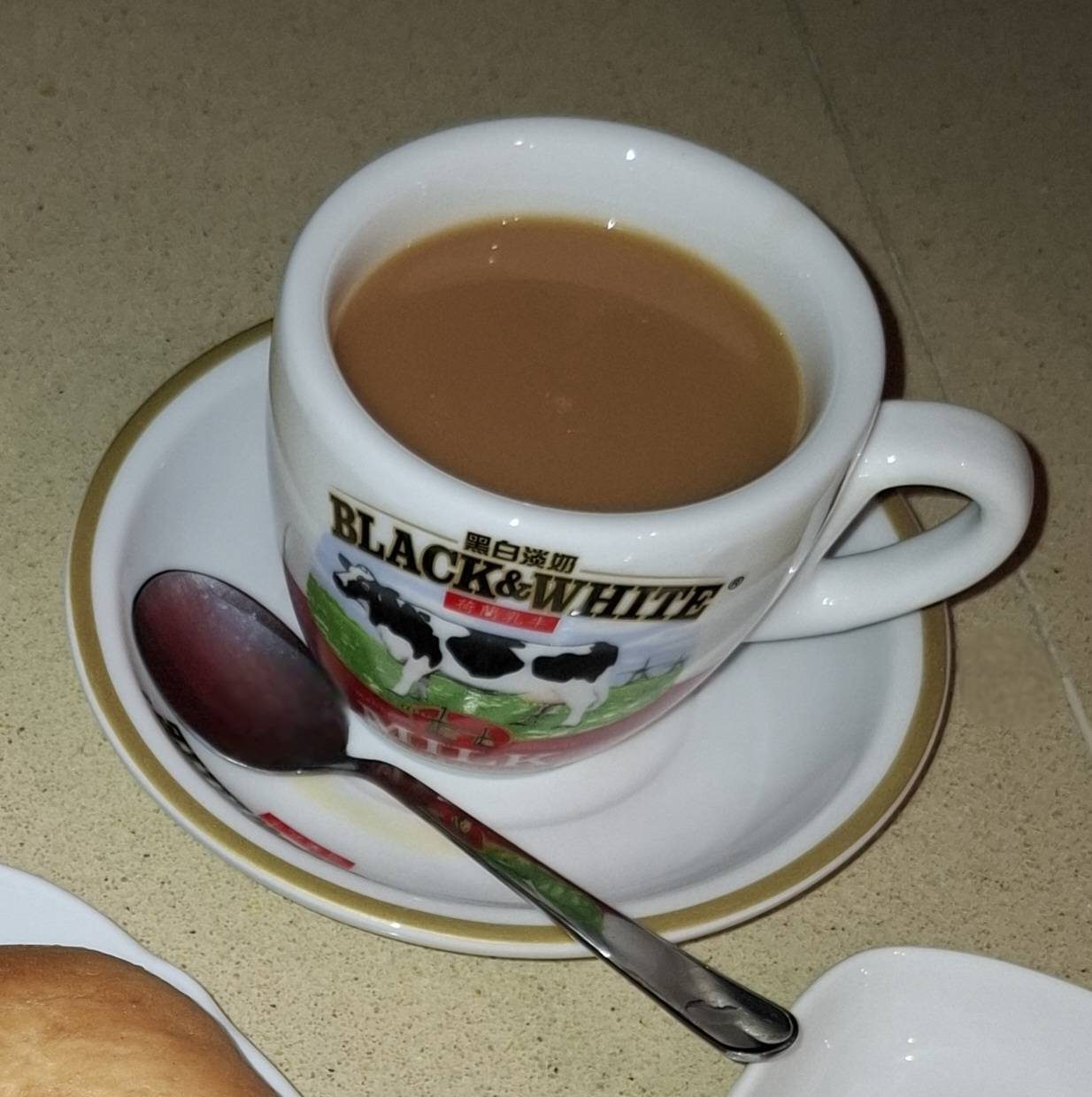
Hong Kong Milk Tea (絲襪奶茶, Silk Stocking Milk Tea)
Declassified 22 August 2026
Threat assessment
- 1 No contact Nobody is in danger. Least of all the locals.
- 2 Light resistance A warmth. You mention it. Nobody responds.
- 3 Engaged You are sweating. No one else at the table is sweating.
- 4 Taking fire You have stopped talking. A child has taken your portion.
- 5 Operative down Extraction required. Locals describe this one as "not spicy".
Hong Kong milk tea is a blend of coarse and fine Ceylon-type black teas brewed strong, repeatedly poured — "pulled" — through a cotton sackcloth filter, then cut with full-fat evaporated milk rather than fresh milk. The nickname comes from the filter itself, which stains to the colour of a tea-brown silk stocking after a few brews. A good one is opaque and toffee-coloured rather than grey, thick enough to cling to the side of the cup, and bitter only in the way strong tea should be; the pulling is what aerates it and rounds the tannins off. It is the house drink of every cha chaan teng in the city, and the making of it was listed on Hong Kong's first intangible cultural heritage inventory in 2014. Photo: Nikoletic126 (CC0), via Wikimedia Commons.
// SUPPLY LIST
SCALE:
| AMT | UNIT | ITEM |
|---|---|---|
| 1.5 | l | Boiling water, for seasoning a new cotton sock filter and for warming the pans and cups |
| 15 | g | Ceylon tea fannings or dust, for the sacrificial seasoning brew only (discarded, and separate from the measured blend below) |
| 22 | g | Ceylon broken orange pekoe, coarse-cut loose leaf, for aroma and backbone |
| 28 | g | Ceylon tea fannings or dust (幼茶), loose, or emptied from 12-14 bags of a strong supermarket Ceylon, for colour and body |
| 5 | g | Ripe pu-erh (shou), loose leaf, for the low earthy note under the tannin |
| 1 | l | Fresh cold filtered or still bottled water, low mineral, drawn just before brewing |
| 240 | ml | Full-fat evaporated milk, ideally Black & White (黑白淡奶) at about 8% fat, at room temperature |
| White granulated sugar, served at the table |
// OPERATIONS
- 1 Season a new cotton sock filter before its first use, because raw sackcloth tastes of cloth: drop the 15 g of sacrificial Ceylon dust into the bag, seat it in a 2-litre stainless steel pan, pour over 1 litre of the boiling water and simmer for 10 minutes at about 95C/203F, then leave it off the heat for 20 minutes until the cloth has stained an even tobacco brown right through the seams — a bag still showing white patches will taste of cotton in the first pot. Throw that brew away. Never wash the bag with detergent: soap soaks into cotton and stays there, and every pot afterwards carries a faint washing-up-liquid note. Rinse it only under water as hot as the tap runs, and store it damp and submerged in cold water in a covered container in the fridge so it never dries stiff or sours. An already-seasoned sock skips this step.
- 2 Weigh and blend the tea while the sock is staining: tip 22 g coarse Ceylon broken orange pekoe, 28 g Ceylon fannings or dust and 5 g ripe pu-erh into a bowl and toss with your fingers until the grades are evenly distributed and no pocket of dust is left sitting at the bottom. Each grade does a different job — the coarse leaf carries aroma and structure, the fannings and dust give the opaque colour and the body that lets the tea survive being cut a quarter with evaporated milk, and the pu-erh lays a soft earthy floor under the tannin. Do not brew 55 g of a single grade, and do not let the coarse leaf dominate: leaf-heavy blends give a perfumed tea that vanishes under the milk and is the usual reason a homemade cup comes out grey, while dust alone gives a flat, muddy, aggressively bitter one. Buying fannings loose is ideal, but slitting open twelve to fourteen bags of a strong supermarket Ceylon (Lipton Yellow Label and its equivalents are fannings) is what most Hong Kong home kitchens actually do, and it is not a compromise.
- 3 Bring the 1 litre of fresh cold water to a full rolling boil (100C/212F) in a 2-litre stainless steel pan, and warm a second 2-litre stainless steel pan alongside with a splash of the remaining boiling water. Both vessels go on the hob later in the brew, so this has to be a second pan and not a jug. Draw the water fresh and boil it once: water that has sat in the kettle and been reboiled has lost its dissolved air and makes noticeably duller, flatter tea.
- 4 Put the 55 g blend into the seasoned sock, seat the filter ring over the second pan so the bag hangs inside it, and pour the boiling water through the tea in one steady stream from about 30 cm above the bag — the leaf should churn and bloom rather than sit in a wet clump. Set that pan over medium heat with the loaded sock still sitting in the tea, bring it back to a bare simmer at 95C/203F (surface trembling, a few lazy bubbles at the rim, never a rolling boil) and cook for 3 minutes, by which point the liquor should be near-black and no longer see-through against the side of the pan. Past 4 minutes at a simmer the tannins turn hard and drying, and no amount of pulling afterwards will soften them.
- 5 Now pull the tea (撞茶): lift the sock out, let it drain for two seconds, hold it over the first pan and pour the hot tea from the second pan through the leaves in the bag in an unbroken thin stream from 30-40 cm up, then swap the pans and repeat — five or six pours in all, about 4 minutes' work, the tea shedding heat from roughly 95C/203F to about 88C/190F as it aerates. Keep the stream continuous and the drop high; this is aeration, not decanting, and it is the single step that turns harsh tea silky. You are looking for a fine, close, beige foam on the surface like the head on stout — big loose bubbles that collapse at once mean you are pouring too slowly or from too low, and a stream that breaks into droplets on the way down means you are pouring too fast.
- 6 Return the sock and its leaves to the pan of pulled tea, cover, take it off the heat entirely and let it steep (焗茶) for 6 minutes, over which it will fall to roughly 85C/185F. This is where the body arrives — the liquor should thicken enough to coat the back of a cold spoon rather than run straight off it; skip this rest and you get tea that is strong but thin, and that thinness is instantly obvious the moment the evaporated milk goes in.
- 7 Pull the tea twice more between the two pans to re-aerate it and settle it at pouring heat, about 80C/176F — every high pour sheds a few degrees, so it will be cooler than it was at the end of the steep, not hotter. Lift the sock out and press it gently against the side of the pan with the back of a spoon to release the last of the liquor, but do not wring or squeeze it hard: that forces out the bitter, astringent tail of the extraction and leaves the finished cup dry and pinched. You should have about 740-780 ml of very dark, opaque tea; if you are short of the 720 ml the cups need, top up with a splash of just-boiled water rather than cutting the milk.
- 8 Warm four thick 300 ml ceramic cups with the last of the boiling water for 30 seconds and tip it out, then pour 60 ml of room-temperature full-fat evaporated milk into each cup: the milk goes in first, exactly as it does at the counter of a cha chaan teng, so the tea mixes itself on the way down. Use cups with headroom — 60 ml of milk plus 180 ml of tea fills a 240 ml cup to the brim with nowhere to stir. Never heat the evaporated milk in a pan: above about 80C/176F it takes on a cooked, faintly eggy taste and throws a skin, and no amount of tea will disguise it.
- 9 Pour about 180 ml of the hot tea (78-80C/172-176F) into each cup from around 20 cm above the rim so it mixes on the way down, stopping about 1 cm below the rim, and stir once. The colour is the test: a good cup reads as opaque toffee or milk chocolate, never grey, and never translucent where it meets the side of the cup. Grey and thin means the brew was under-strength or under-pulled, and the fix is more tea, not less milk — pull the rest of the pot twice more now, and add 5 g extra fannings to the blend next time.
- 10 Serve unsweetened with a bowl of white granulated sugar and a spoon alongside, and let each drinker stir in 1 1/2 to 2 teaspoons while the cup is still hot enough to dissolve it cleanly. Sweetening the whole pot is a takeaway-counter shortcut that flattens the tea and takes the choice away from the person drinking it. Drink it within 20 minutes: held hot on the hob, milk tea dulls, stews and turns papery inside half an hour, and reheating it hard enough to matter will split the milk into grey flecks.
- 11 Serve with the classic cha chaan teng partners — a hot pineapple bun split around a cold slab of butter (菠蘿油), thick-cut French toast with condensed milk, or a scrambled egg sandwich on soft white bread. For iced milk tea (凍奶茶), brew exactly as above but with 65 g of blend to the same litre of water, sweeten it while it is still hot if you want it sweet, then chill the finished milked tea in a covered jug in the fridge at 4C/39F for at least 3 hours before pouring it over ice; never build it hot over ice, which waters it to grey in seconds.