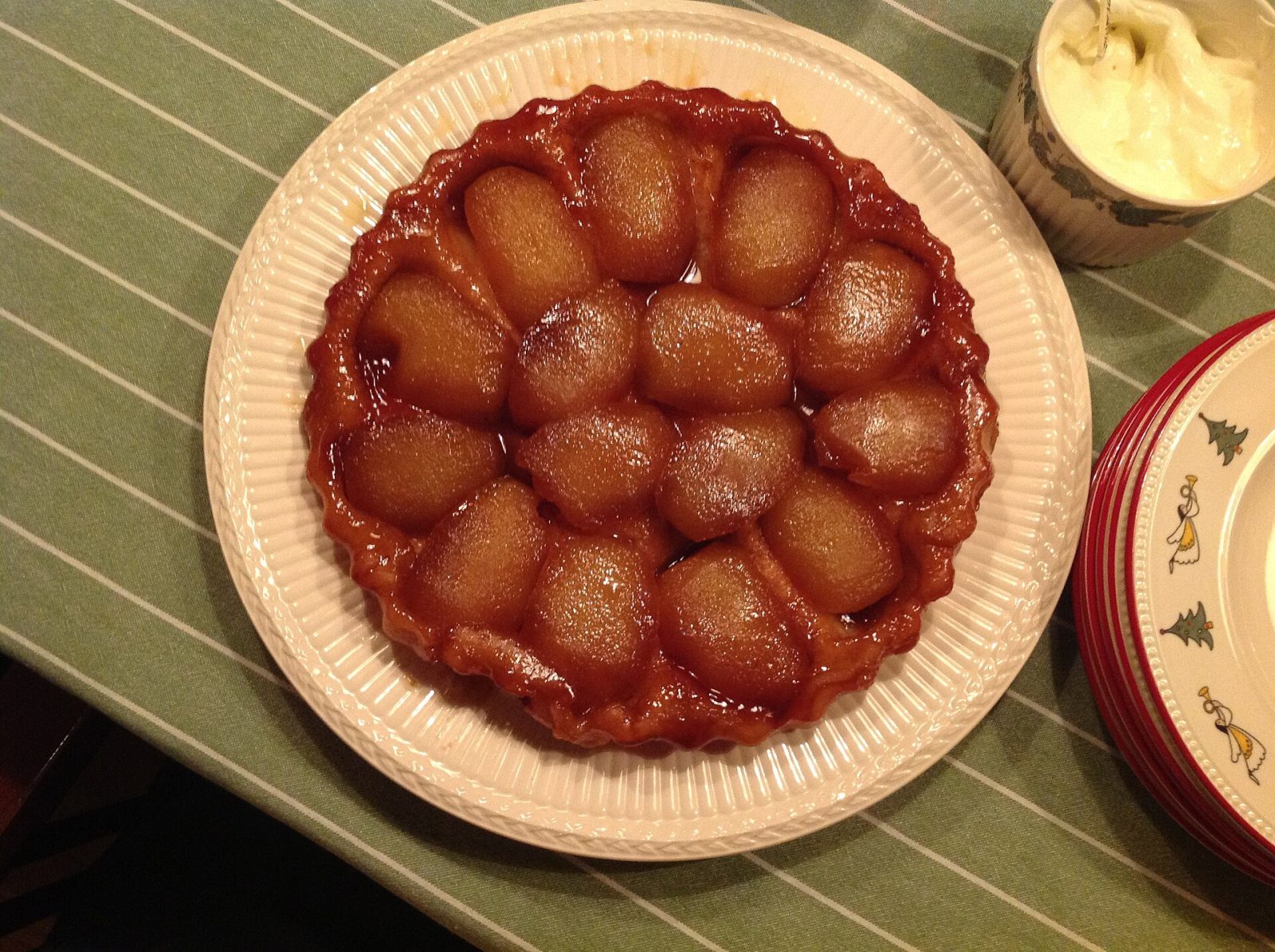
Tarte Tatin (Tarte des Demoiselles Tatin)
Declassified 22 August 2026
Threat assessment
- 1 No contact Nobody is in danger. Least of all the locals.
- 2 Light resistance A warmth. You mention it. Nobody responds.
- 3 Engaged You are sweating. No one else at the table is sweating.
- 4 Taking fire You have stopped talking. A child has taken your portion.
- 5 Operative down Extraction required. Locals describe this one as "not spicy".
An upside-down apple tart from Lamotte-Beuvron in the Sologne, where the Tatin sisters ran the hotel opposite the railway station and, so the story goes, rescued a mishandled apple tart by baking it upside down. Apples are packed into a butter-and-sugar caramel made directly in the pan, cooked down on the hob until they are translucent and the caramel is deep amber, then covered with pastry, baked, and turned out hot. A good one is dark and glossy rather than pale and syrupy, tall from tightly packed fruit rather than a single sparse layer, and made with an apple that holds its shape — a reinette or a boskoop, never a soft cooker. Everything rests on two judgements: how far you take the caramel, and how long you are willing to cook the apples before the pastry ever goes on. Photo: Djenghisz (CC BY-SA 3.0), via Wikimedia Commons.
// SUPPLY LIST
SCALE:
| AMT | UNIT | ITEM |
|---|---|---|
| 200 | g | Plain flour (French T55 or UK plain), plus extra for dusting |
| 100 | g | Unsalted butter for the pastry, cold from the fridge, cut into 1 cm dice |
| 3 | g | Fine sea salt, for the pastry |
| 10 | g | Caster sugar for the pastry |
| 45 | ml | Ice-cold water |
| 1.8 | kg | Firm reinette-type apples (reinette grise du Canada, belle de Boskoop, reine des reinettes; Cox or Braeburn as substitutes), peeled, quartered and cored — about 10 medium, giving roughly 1.3 kg prepared |
| 0.5 | Lemon, juice only | |
| 110 | g | Unsalted butter for the caramel, cut into 1 cm pieces |
| 150 | g | Caster sugar for the caramel |
| 1 | pinch | Fleur de sel or flaky sea salt, for the caramel |
| 250 | g | Crème fraîche, thick and full-fat (crème d'Isigny if you can get it), chilled, to serve |
// OPERATIONS
- 1 Make the pâte brisée: rub the 100 g cold diced butter into the flour with the 3 g fine salt and 10 g sugar using fingertips only, lifting the mixture as you go, until it looks like coarse breadcrumbs studded with flattened pea-sized flakes of butter — those visible flakes are what makes the crust short. Add the 45 ml ice water all at once and gather the dough, adding no more than one extra teaspoon of water if dry crumbs refuse to come in, then give it two or three smearing pushes with the heel of your hand (fraisage) and stop: knead it properly and gluten will make the disc shrink off the apples in the oven and let the caramel flood over the pastry. Flatten into a 15 cm disc, wrap, and chill at least 1 hour and up to 2 days — soft, warm pastry will not hold its shape on a hot pan. A bought all-butter puff sheet (pur beurre, about 230 g, 3 mm thick) is used in plenty of Sologne kitchens and is a shortcut nobody will challenge you on; a cheap margarine-based one goes greasy and limp under the caramel, so read the label.
- 2 While the pastry chills, peel, quarter and core the apples, cutting the core out generously so no woody edge survives the cooking, and turn them in the juice of the half lemon in a large bowl to stop them browning. Weigh them if you can: you want about 1.3 kg of prepared fruit for a 24 cm pan, which looks absurd in the bowl until it collapses by close to half on the hob. Do not substitute Bramley, McIntosh or anything sold as a 'cooker' — they break down into sauce on the hob and the finished tart turns out as apple purée in caramel with no wedges to show.
- 3 Set a 24 cm (9.5 inch) heavy cast-iron or copper tatin mould, or a heavy oven-safe skillet with sides at least 5 cm deep, over medium heat and melt the 110 g butter. Scatter the 150 g sugar evenly across the surface and add the pinch of fleur de sel. Cook without stirring for 5 to 8 minutes, tilting the pan occasionally, until the sugar has melted through the butter and the mixture is a pale hazelnut blond that smells of toffee. It will look slightly separated and grainy at this stage, which is normal — the juice the apples release next is what pulls it back into a smooth caramel — but if it is still white and sandy, keep going, because sugar left unmelted now stays gritty in the finished tart.
- 4 Take the pan off the heat and pack the apple quarters in rounded side down against the caramel, each one tipped slightly onto a cut face so it leans against its neighbour like a fallen domino, in tight concentric rings working from the outside in — the domed side touching the caramel is the face you will see when the tart is turned out, so keep it clean and unbroken. Wedge them hard against one another until there is no daylight between them, then lay a second layer of quarters flat across the top, filling every gap and pressing down. A loosely packed pan is the single most common reason a tatin falls apart on the plate: the apples must already be under pressure from each other before the heat goes back on.
- 5 Put the oven on now to preheat to 190°C / 375°F conventional (170°C fan), with a shelf in the middle and a baking tray on the shelf below to catch any caramel that boils over, then return the pan to medium heat and cook, uncovered, for 30 to 35 minutes, pressing the apples down firmly with a spatula every 10 minutes as they soften and settle and tilting the pan now and then to spoon the caramel from the edges over the fruit. It is ready when the caramel has gone from blond to a deep amber the colour of old copper and bubbles thickly and slowly rather than in thin watery bursts, and a knife tip slides into a quarter with only slight resistance while the cut edges look translucent. Do not shorten this and go straight to the oven — the apples will dump their water under the pastry and you get a pale, soupy tart with a raw-tasting caramel. Equally, stay at the pan for the last 5 minutes: amber turns to bitter black in under a minute, and once it smells of smoke rather than toffee it is already gone.
- 6 Slide the pan off the heat and let it stand 5 minutes while you roll the chilled pastry on a lightly floured surface into a 28 cm disc about 3 to 4 mm thick, pricking it all over with a fork, about 15 times, so steam escapes instead of doming the crust off the fruit. That short settle matters: chilled pastry dropped straight onto a pan fresh off 35 minutes of direct heat loses its butter into the caramel before it ever reaches the oven, and bakes greasy and flat underneath.
- 7 Drape the pastry over the apples and, working quickly with the back of a spoon or a round-bladed knife (the pan is still very hot — do not use your fingers), tuck the 2 cm of overhang down inside the rim of the pan all the way round so the pastry sits as a lid sealed against the fruit. Tuck rather than trim flush: the tucked edge becomes a raised rim of pastry that holds the caramel in when you invert the tart, whereas pastry cut level with the rim lets it run straight off the plate.
- 8 Bake at 190°C / 375°F for 30 to 35 minutes, until the pastry is deep golden brown and dry and firm when tapped, and the caramel is bubbling thickly around the edge of the pan. Pale pastry means an underbaked, doughy base once the tart is inverted and that crust has to sit under wet fruit — give it the extra five minutes rather than pulling it early.
- 9 Rest the tart in its pan on a rack for 15 to 20 minutes, and no longer than 30: this window lets the caramel thicken enough to cling to the apples instead of running everywhere, but past 30 minutes it sets like glue and the fruit welds itself to the pan. If it does seize, put the pan back over a low flame for 30 to 60 seconds until you hear the caramel loosen and the whole mass gives a faint slide when you nudge the pan. To turn out, run a knife around the rim, set a flat serving plate larger than the pan face-down on top, hold plate and pan together with a dry cloth over both hands, and invert in one decisive movement — a hesitant flip is what slides the apples sideways.
- 10 Lift the pan off, and if any quarters have stayed behind, lift them out with a palette knife and press them straight back into their places on the tart while everything is still hot and pliable, then scrape every drop of caramel from the pan over the top. Serve it warm, within the hour, in wedges cut with a serrated knife, with a spoonful of cold thick crème fraîche alongside each slice — that, or nothing at all, is how it is served in the Sologne; ice cream is a modern addition and melts the caramel into a puddle on the plate.