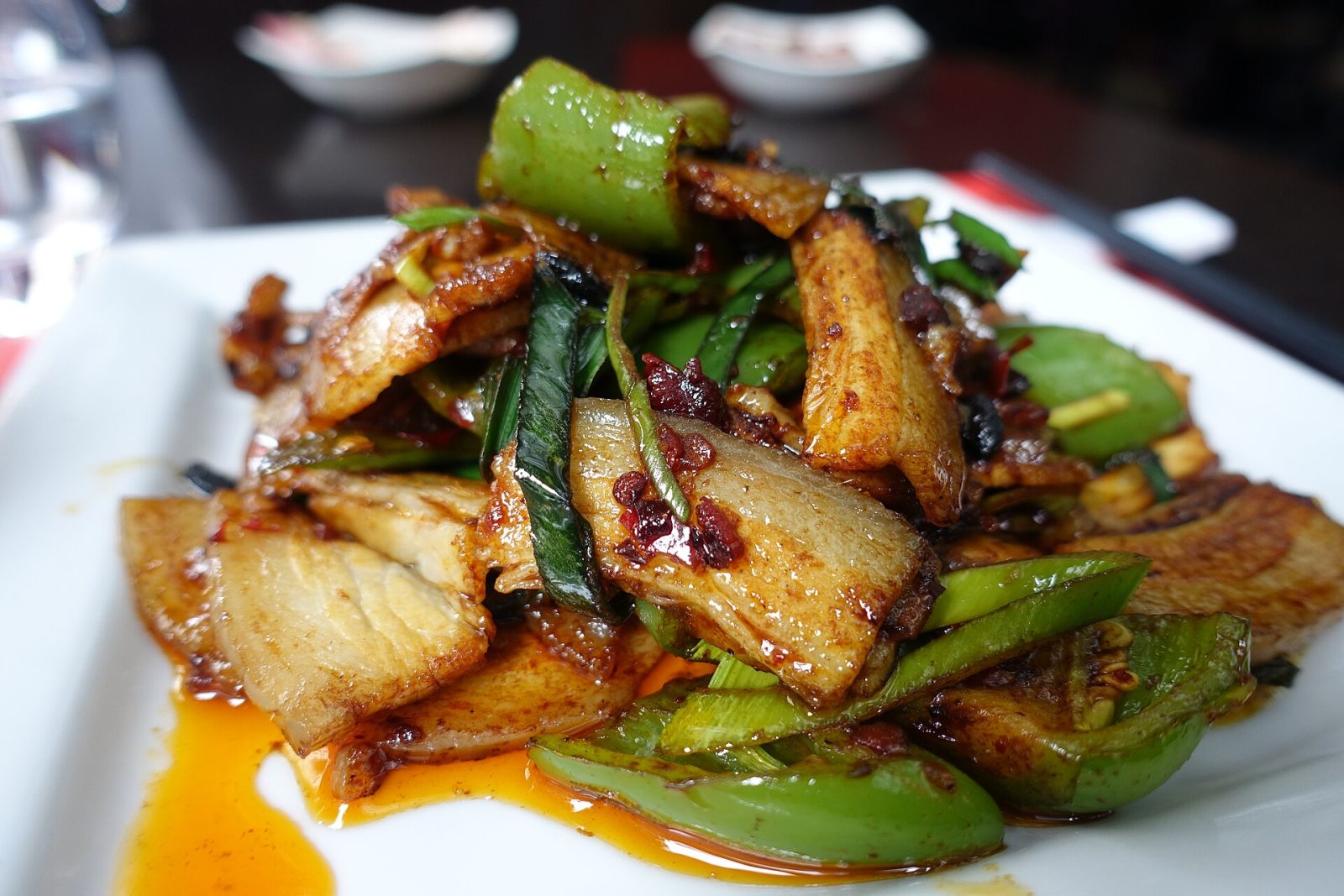
Twice-Cooked Pork (回锅肉)
Declassified 22 August 2026
Threat assessment
500 SHUMILD
- 1 No contact Nobody is in danger. Least of all the locals.
- 2 Light resistance A warmth. You mention it. Nobody responds.
- 3 Engaged You are sweating. No one else at the table is sweating.
- 4 Taking fire You have stopped talking. A child has taken your portion.
- 5 Operative down Extraction required. Locals describe this one as "not spicy".
Huiguorou is the dish Sichuanese cooks call chuancai zhi shou, the head of Sichuan cuisine: a whole piece of skin-on pork is poached with ginger and Sichuan pepper, chilled hard, sliced paper-thin, then returned to the wok — twice cooked — until the slices curl into little lamp cups in their own rendered fat. Pixian doubanjiang, sweet tianmianjiang and fermented black beans are fried into that fat, and garlic greens go in at the very last moment. A good one is glossy and dry rather than saucy, deeply savoury and only gently hot, with the fat rendered to a soft translucent chew instead of grease. Almost every decision that matters — the cut, the gentle poach, the cold block, the thin slice — is made before the wok is even hot. Photo: Guilhem Vellut from Paris, France (CC BY 2.0), via Wikimedia Commons.
// SUPPLY LIST
SCALE:
| AMT | UNIT | ITEM |
|---|---|---|
| 500 | g | Erdao rou (the rump cut off the top of the hind leg), skin on, in one unbroken piece 4-5 cm thick; ordinary skin-on pork belly is the accepted home substitute |
| 25 | g | Ginger, unpeeled, bashed flat and cut into 5 thick coins |
| 2 | stalk | Scallions, whole, tied into loose knots |
| 1 | tsp | Red Sichuan peppercorns (Hanyuan or Da Hong Pao), whole |
| 1 | tbsp | Shaoxing wine, for the poaching water |
| 1 | tbsp | Caiziyou (roasted rapeseed oil) or any neutral oil |
| 25 | g | Pixian doubanjiang, broad beans chopped fine with a knife |
| 12 | g | Tianmianjiang (sweet flour paste) |
| 5 | g | Douchi (fermented black beans), rinsed 10 seconds and roughly chopped |
| 2 | tsp | Shaoxing wine, for the wok |
| 1 | tsp | Light soy sauce |
| 0.5 | tsp | Sugar, only if your tianmianjiang leans more salty than sweet |
| 130 | g | Garlic greens (suanmiao), fat whites split lengthwise, cut on a steep diagonal into 5 cm lengths, whites and greens kept in separate piles |
| 225 | g | Long-grain or jasmine rice, uncooked, to steam and serve alongside |
// OPERATIONS
- 1 Buy the right cut: ask for erdao rou, the second cut taken off the top of the hind leg immediately below the tail-bone section, skin on, 4-5 cm thick, showing a clean sandwich of skin, a 1-1.5 cm band of fat and lean beneath it, in one unbroken 500 g piece. It is a rump cut, not belly, and it should read as roughly four parts fat to six parts lean. Every home kitchen in Chengdu that cannot get it uses ordinary skin-on pork belly and nobody blinks, so if erdao rou is out of reach buy the thickest, most evenly layered belly on the counter. What you must not accept is a skinless piece or one that is mostly fat: the skin is what holds each slice together while it curls, and without it you get flat ribbons.
- 2 Put the pork in a 22 cm saucepan and cover with 2 litres of cold water, enough that it sits under at least 3 cm of liquid with room to spare — any shallower and the exposed face dries out and cooks unevenly. Add the ginger, scallion knots, Sichuan peppercorns and 1 tbsp Shaoxing, bring to a boil over high heat, and skim the grey foam off for the first 2 minutes. Then drop the heat until the water is at a bare shiver, 85-90 C / 185-195 F, with bubbles breaking only around the rim of the pan, and cook 25-30 minutes for a 4-5 cm thick piece. Do not salt the water and do not let it return to a rolling boil: hard boiling tightens the lean into strings and splits the skin, and those slices will disintegrate in the wok.
- 3 Test from 25 minutes by pushing a bamboo skewer through the thickest lean. It should enter with a little resistance, like firm cheese, and the juice that follows it out should run clear with no pink thread. You want the pork just cooked through and no further, because the wok finishes it and the 20-minute steep that follows carries it on. Pork poached until the skewer slides in with no resistance at all is already overdone and will crumble in the pan instead of curling into lamp cups.
- 4 Turn off the heat and leave the pork sitting in its own broth for 20 minutes, until the broth is merely warm rather than hot; this keeps the lean from drying out and lets the fat set. Lift it out, pat it completely dry, wrap it loosely and refrigerate for at least 2 hours or overnight, until the centre is properly cold, about 4 C / 39 F, and the block feels firm under your thumb. In a hurry, 40 minutes in the freezer gets you to the same firmness, though the classic approach is simply to poach the pork the day before. Slicing this pork while it is still warm is the single most common reason home versions fail: warm pork tears into thick ragged pieces that will never curl.
- 5 With the sharpest knife you own, slice the cold block across at a slight angle into pieces 2-3 mm thick and roughly 5 x 4 cm, each one carrying skin, fat and lean together. Held up to a window, a good slice is faintly translucent through the lean. Thinner than 2 mm and they fry into crisps that lose all chew; much over 3 mm and they stay flat in the wok and the dish tastes like boiled pork sitting in paste.
- 6 Prep everything else before the wok goes near the flame. Chop the doubanjiang finely on a board, because whole broad beans will not release their colour or fragrance into the fat; rinse the douchi under the tap for 10 seconds to wash off surface salt and chop it roughly; cut the garlic greens on a steep diagonal into 5 cm lengths, splitting any thick whites lengthwise, and keep whites and greens in separate piles. Get the rice steaming now too, so it is ready when the wok is. From the moment the pork hits the wok you have under 5 minutes and no free hands.
- 7 Heat a 30-35 cm carbon steel wok over the highest flame you have until a thin wisp of smoke rises off the surface, about 200-230 C / 390-450 F, add the 1 tbsp oil and swirl it up the sides, then lay in the pork in as close to a single layer as it will go. Leave it undisturbed for 40 seconds, then toss and keep it moving for another 2-3 minutes: the white fat turns glassy and translucent, the edges brown and blister, and the slices arch up into dengzhan wo, little curled lamp cups, with 2-3 tbsp of clear fat pooling underneath. Add no more oil at any point, because the dish is meant to fry in the pig; if more than 3 tbsp of fat has run out, spoon the excess into a jar and leave about 2 tbsp in the wok.
- 8 Push the pork up the far wall of the wok and turn the heat down to medium-low, roughly 150 C / 300 F, so the fat stops shimmering hard. Add the chopped doubanjiang to the pool of fat at the bottom and press and stir it for 25-40 seconds, until the fat stains a deep brick red and the smell turns round and fragrant instead of sharp and raw. This is the step that ruins the dish: over a full flame the paste scorches in under 10 seconds, the wok goes muddy brown and the whole thing tastes bitter, and there is no recovering it.
- 9 Stir the tianmianjiang and douchi into the red fat and cook 15 seconds more, until the sweet paste loosens and smells toasty, then push the heat back to high and fold the pork down through it for 20-30 seconds, until every slice is lacquered and glossy. Pour the 2 tsp Shaoxing around the hot rim of the wok so it flashes off, add the 1 tsp light soy, taste one slice and add the 1/2 tsp sugar only if your tianmianjiang is on the salty side. Add no water, no stock and absolutely no cornstarch slurry: huiguorou is a dry fry dressed by rendered fat and paste, and any liquid at all turns it into a dull, gravied braise.
- 10 Throw in the garlic-green whites and toss hard for 25 seconds, until they lose their raw bite and take a little colour at the cut edges, then add the greens and toss for a final 15-20 seconds only. They should wilt just enough to go glossy while staying bright green and crunchy at the core. Any earlier or any longer and they collapse to khaki, and the dish loses the fresh sulphurous lift that is the only thing cutting through all that fat.
- 11 Tip it straight from the wok onto a warmed plate and eat it within a minute or two. There is deliberately no rest at this end of the recipe, because the rest already happened in the fridge, and rendered pork fat sets dull and waxy as it cools. Serve with the plain steamed long-grain or jasmine rice to carry the salt, and if you are building a Sichuan table around it, add a clear vegetable soup and a cold smashed-cucumber salad. It reheats badly, so cook only what will be eaten.