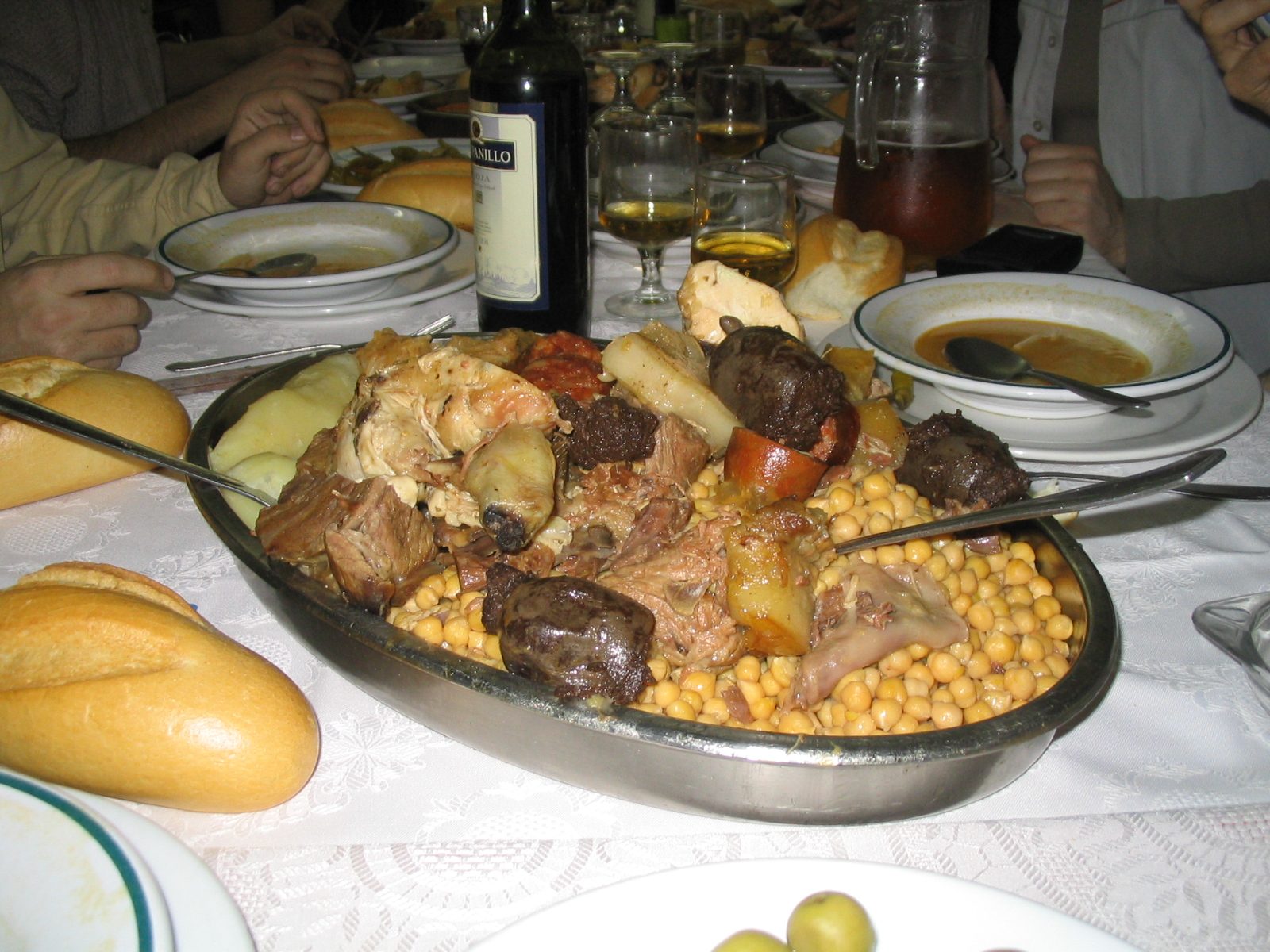
Cocido Madrileño (Madrid Boiled Dinner)
Declassified 22 August 2026
Threat assessment
- 1 No contact Nobody is in danger. Least of all the locals.
- 2 Light resistance A warmth. You mention it. Nobody responds.
- 3 Engaged You are sweating. No one else at the table is sweating.
- 4 Taking fire You have stopped talking. A child has taken your portion.
- 5 Operative down Extraction required. Locals describe this one as "not spicy".
Cocido madrileño is the Sunday stew of Madrid: chickpeas, beef shin, stewing hen, cured pork and two sausages simmered for hours in one pot, then served as three separate courses — a noodle soup drawn from the broth, then the chickpeas and vegetables, then the meats. A good one is judged on its broth, which should be clear and deep gold rather than cloudy or greasy, and on its chickpeas, which stay whole and creamy with their skins intact. Almost everything that goes wrong is a question of temperature: too hard a boil, or cold water added to a hot pot. The cabbage is cooked in a second pan, as it is in most Madrid kitchens, so it cannot turn the broth grey. Photo: Tnarik (CC BY-SA 2.0), via Wikimedia Commons.
// SUPPLY LIST
SCALE:
| AMT | UNIT | ITEM |
|---|---|---|
| 500 | g | Dried chickpeas, garbanzo castellano or pedrosillano, for overnight soaking |
| Fine sea salt, 1 tbsp for the soak plus more for finishing the broth | ||
| 1 | tsp | Bicarbonate of soda, for the soak |
| 600 | g | Beef shin (morcillo), boned, in two thick pieces |
| 400 | g | Stewing hen (gallina), leg and thigh quarter, skin on |
| 120 | g | Salted pork fatback or streaky tocino, in one unsliced piece |
| 1 | piece | Serrano ham bone (hueso de jamón), sawn into two pieces by the butcher |
| 250 | g | Beef marrow bone (hueso de caña), cut into two lengths |
| 1 | Onion, peeled and left whole, studded with 1 whole clove | |
| 1 | Cloves, whole, for studding the onion | |
| 80 | g | Day-old white bread, crusts removed, torn into fine crumbs, for the relleno |
| 2 | Eggs, beaten | |
| 2 | tbsp | Flat-leaf parsley leaves, finely chopped |
| 5 | clove | Garlic cloves, 2 finely minced for the relleno, 3 thinly sliced for the cabbage |
| 2 | tbsp | Plain flour, for dusting the relleno |
| 5 | tbsp | Extra virgin olive oil, 2 tbsp for the relleno and 3 tbsp for the cabbage |
| 300 | g | Carrots, peeled and left whole |
| 200 | g | Cooking chorizo for cocido, mild and semi-cured, left whole and unpricked |
| 500 | g | Waxy potatoes, peeled and halved into roughly 5 cm pieces |
| 600 | g | Green cabbage (repollo), cut into 6 wedges through the core |
| 180 | g | Morcilla de cebolla, the onion blood sausage without rice, left whole and unpricked |
| 1 | tsp | Sweet pimentón (dulce), not hot, for the cabbage refrito |
| 150 | g | Fideos, fine soup noodles no. 1 or no. 2 |
// OPERATIONS
- 1 Put the chickpeas in a large bowl with 2.5 litres of warm water (about 40°C/104°F), 1 tablespoon of fine sea salt and the teaspoon of bicarbonate of soda, and leave them 12 to 14 hours at room temperature — in a kitchen warmer than about 24°C/75°F soak them in the fridge instead, or they ferment, foam and sour. The salt and bicarbonate soften the skins, which matters because hard water sets them, and loose burst skins floating in the broth are the mark of a careless cocido. They should roughly double in size, and a chickpea split with a thumbnail should show no chalky opaque core; if it does, give them another 2 hours, because one that goes into the pot under-soaked will still be gritty three hours later and nothing afterwards rescues it. Drain, rinse well under cold water to wash the bicarbonate off, and tie them loosely into a muslin or netting bag (the redecilla) with at least a third of the bag left empty so they can swell and move.
- 2 Put the beef shin, hen quarter, tocino, ham bone and marrow bone into a tall 8 to 10 litre stockpot — tall and narrow rather than wide, so less broth evaporates and the meats stay submerged — and cover with 4.5 litres of cold water. Bring it to the boil slowly over medium heat, which should take 25 to 30 minutes: starting cold and heating gently drives the proteins out as scum you can lift off, whereas a fast boil sets them into the liquid as a permanent grey cloud. Skim the greyish foam every couple of minutes with a slotted spoon until what rises is white and fine, about 10 minutes of work, and add no salt whatsoever at this stage — the ham bone, tocino and chorizo will salt the pot for you and you cannot take it back out.
- 3 With the pot at a full rolling boil — the only moment the main pot should ever boil hard — lower in the bag of chickpeas and the clove-studded onion, and top up with boiling water straight from a kettle so everything is covered by 3 cm. Chickpeas dropped into water that is merely simmering, or shocked later by a cold top-up, seize: the skins toughen and slip, and the insides stay hard however long you cook them, so from here to the end every drop you add must go in at a boil.
- 4 Bring it back to the boil, then drop the heat until the surface only trembles — 90 to 95°C / 194 to 203°F, one lazy bubble breaking every second or two — set the lid ajar and hold it exactly there for 2 hours 30 minutes. A rolling boil at this stage is the single most common way a home cocido is ruined: it emulsifies the fat into the liquid so the broth turns greasy and opaque instead of clear gold, and it shakes the chickpeas into mush. Look in every 40 minutes and top up with boiling water to keep everything covered by 3 cm.
- 5 While the pot simmers — do this well inside those two and a half hours, not in the rushed final half hour — make the relleno: mix the breadcrumbs, beaten eggs, the 2 minced garlic cloves, the parsley and a good pinch of salt, slacken it with 2 to 3 tablespoons of hot broth lifted from the pot, and leave it to stand 10 minutes until it stiffens to a paste that holds its shape on the spoon; if it still crumbles rather than clinging, work in more broth a spoonful at a time. Form two flattened ovals about 10 cm long and 2 cm thick, roll them in the flour, and fry them in 2 tablespoons of olive oil in a small frying pan over medium heat, the oil at about 170°C/340°F, for 2 minutes a side until evenly pale gold and firm enough to lift with a spatula without sagging, then set them aside on a plate. Do not skip the frying to save a pan — an unsealed relleno disintegrates in the broth and clouds it just as you are about to serve.
- 6 At the 2 hour 30 minute mark add the whole carrots and the chorizo, left whole and unpricked so its fat and pimentón leave slowly rather than flooding the pot in the first five minutes, and simmer a further 45 minutes at the same trembling 90 to 95°C / 194 to 203°F. After 10 minutes, tilt the pot slightly and ladle off most of the orange fat that gathers at the edge, leaving only a thin film — a cocido broth should taste of chorizo, not swim in it.
- 7 Thirty minutes before the end slip the halved potatoes into the pot, and five minutes after them lower in the fried relleno so it gets the last 25 minutes to swell and set through. Keep the heat exactly where it is so both poach rather than tumble: the potatoes are done when a skewer slides through with the very slightest drag, and if you let the pot come to a real boil now they shed starch, thicken the broth towards a purée and knock the relleno apart.
- 8 Cook the cabbage in a separate pan, never in the main pot: put the wedges in a wide saucepan, add 4 or 5 ladles of broth taken from the cocido and simmer 20 to 25 minutes until a knife passes through the stem with no resistance. This is not a shortcut but the correct Madrid method — cabbage boiled with the chickpeas turns the broth sulphurous and grey-green and stains the chickpeas a dull khaki. Lay the morcilla in alongside it for the same 20 to 25 minutes and poach it below a simmer, around 85°C/185°F, unpricked and never boiling, or the skin splits and the whole pan goes black; if you want the cabbage bright rather than tinted dark, poach the morcilla in a small pan of broth of its own.
- 9 Lift the cabbage out, drain it well, squeeze it gently and chop it coarsely. Heat 3 tablespoons of olive oil in a frying pan over medium heat until it shimmers, about 150°C/300°F, fry the 3 sliced garlic cloves for about 90 seconds until pale gold, then take the pan right off the heat and only now stir in the pimentón — on a live flame pimentón scorches bitter in under 10 seconds and there is no saving it. Return the pan to low heat, add the cabbage and toss 2 to 3 minutes until glossy, brick-red and evenly coated.
- 10 Lift the bag of chickpeas, the meats, the relleno, the potatoes and the carrots onto a warm platter, cover loosely with foil and let everything rest 15 minutes; the pause is also when the last of the fat rises. Strain the broth through a fine sieve into a clean pan — you should have 2.5 to 3 litres — skim it with a ladle or blot the surface with kitchen paper, leaving a few golden eyes of fat for flavour, and only now taste and season with fine salt, which after a ham bone, tocino and chorizo may need very little.
- 11 Measure 1.8 litres of the strained broth into a saucepan, bring it to a brisk boil, scatter in the fideos and cook 2 to 4 minutes, following the packet for your gauge, until just tender with no chalky centre, stirring once or twice so they do not weld to the base. Serve it the moment it is ready — noodles left standing in hot broth go on swelling and turn the sopa to porridge within ten minutes, so if the table is not sitting down, hold the broth hot and cook the fideos at the last second.
- 12 Serve in three vuelcos, the sequence that defines the dish. First the sopa de fideos alone, in warm bowls, with nothing else on the table but bread. Then the second vuelco: tip the chickpeas out of their bag into a warmed dish, arrange the potatoes and carrots around them, put the refried cabbage in its own bowl, and moisten the lot with two ladles of hot broth so nothing dries out.
- 13 For the third vuelco, carve the beef shin across the grain into 1 cm slices, pull the hen into large pieces, cut the chorizo and morcilla into 1.5 cm rounds, cut the tocino into fingers and slice the relleno, and lay them all on a genuinely hot platter — on a cold one the fat congeals in front of your guests. To serve alongside, put out a small jug of plain tomato sauce seasoned with a pinch of ground cumin, a dish of pickled guindillas, a little slivered raw onion, plenty of crusty bread and a light Rioja or a young Ribera del Duero. Any chickpeas and meat left over become ropa vieja the next day, shredded and fried with garlic and the remaining chickpeas until crisp at the edges.