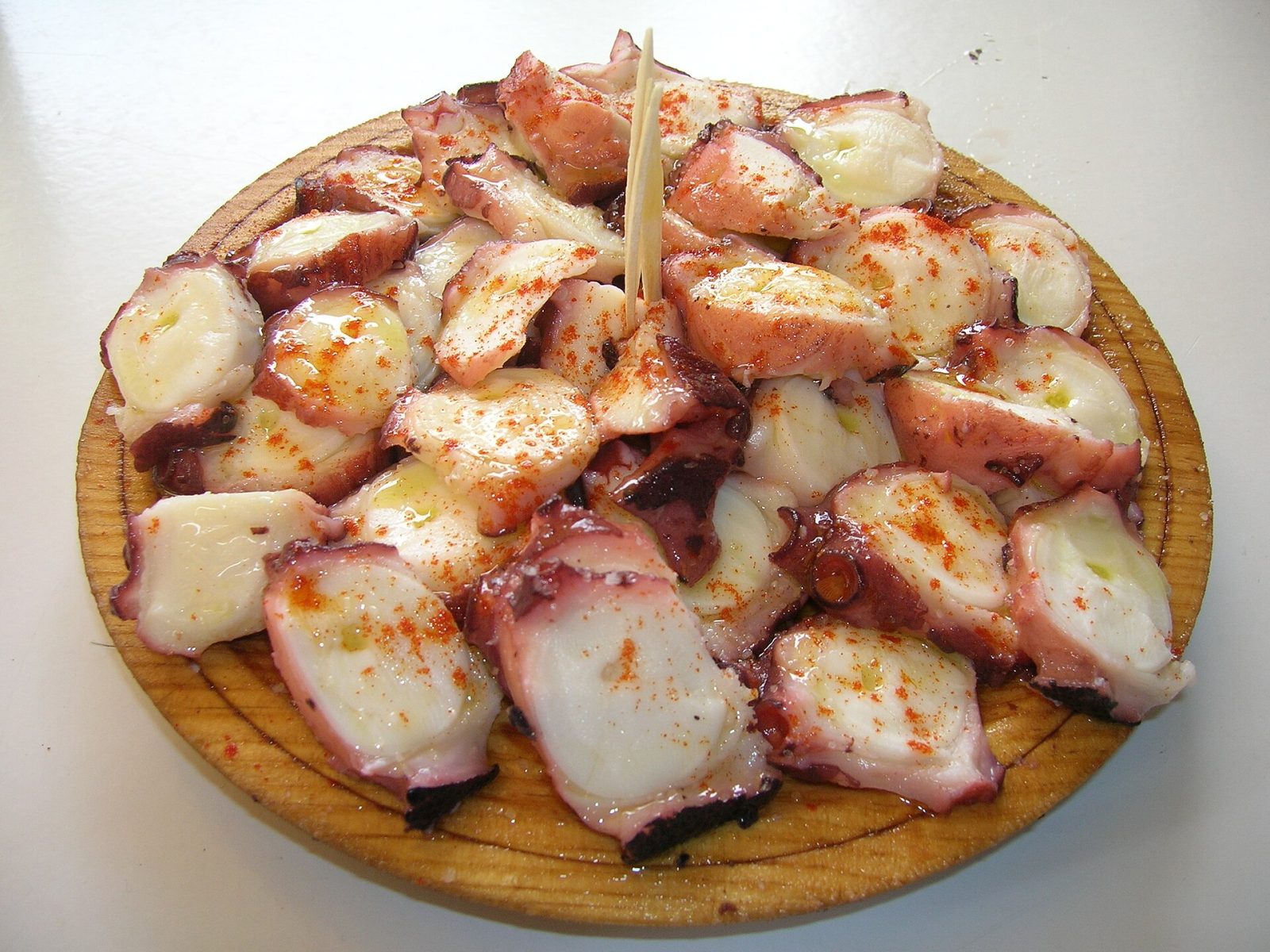
Fair-Style Octopus (Polbo á Feira / Pulpo a la Gallega)
Declassified 22 August 2026
Threat assessment
150 SHUMILD
- 1 No contact Nobody is in danger. Least of all the locals.
- 2 Light resistance A warmth. You mention it. Nobody responds.
- 3 Engaged You are sweating. No one else at the table is sweating.
- 4 Taking fire You have stopped talking. A child has taken your portion.
- 5 Operative down Extraction required. Locals describe this one as "not spicy".
Polbo á feira is the octopus of Galician village fairs: a whole octopus tenderised by freezing, dipped three times into boiling water to set its skin, simmered gently, then cut with scissors over a wooden plate of potatoes boiled in its own broth. It is finished with nothing but coarse salt, pimentón and a generous amount of olive oil — the seasoning is trivial, the texture is everything. A good one is yielding with a faint spring, the skin intact and glossy purple on every coin, never rubbery and never collapsed. Almost everything that decides whether you get that is temperature, not flavour. Photo: Freecat (José Antonio Gil Martínez) from Vigo, Galicia (CC BY 2.0), via Wikimedia Commons.
// SUPPLY LIST
SCALE:
| AMT | UNIT | ITEM |
|---|---|---|
| 2 | kg | Whole octopus, cleaned (beak, eyes and innards removed), frozen — common octopus (Octopus vulgaris) if you can get it |
| 8 | l | Water, for the pot — unsalted, enough to cover the octopus by 5 cm |
| 0.5 | piece | Brown onion, halved through the root, skin left on |
| 900 | g | Floury potatoes for cachelos (Kennebec, the Galician standard, or Agria or Desirée), peeled and cut into 2 cm rounds — not waxy salad potatoes such as Charlotte, which stay hard-edged and never go creamy |
| 45 | g | Coarse sea salt (sal gruesa), for the potato water |
| 15 | g | Coarse sea salt (sal gruesa), for finishing at the table |
| 2 | tsp | Pimentón dulce (sweet paprika), ideally unsmoked Murcian; smoked de la Vera works but shouts louder than it should |
| 1 | tsp | Pimentón picante (hot paprika) |
| 90 | ml | Extra virgin olive oil, fruity Spanish (Arbequina or Hojiblanca) |
| Crusty country bread, to serve |
// OPERATIONS
- 1 Buy a whole cleaned octopus that has been frozen, and if you are handed a fresh one, freeze it solid for at least 48 hours yourself before you start. This is not a shortcut but the method: ice crystals rupture the muscle fibres and do the job the old pulpeiras did by beating the animal thirty or forty times against a stone. Thaw it on a rack set over a tray in the fridge at 3-4°C/37-39°F for 36 hours, then rinse under cold running water, rubbing between the suckers to clear grit and any purple slime, and press the centre where the arms meet to check the beak is out. Never thaw at room temperature or in warm water — the surface goes slack and the skin will shed in the pot.
- 2 Put 8 litres of water and the half onion, skin on, into a tall 12-15 litre stockpot — stainless steel, or the traditional copper caldeiro if you have one, both work — and bring it to a hard rolling boil at 100°C/212°F over your largest burner. Allow 25-30 minutes for that much water to boil and start it before anything else. You want enough depth that the octopus will sit under 5 cm of water once it is in; too little and the exposed arm tips overcook and shred while the head is still raw. Add no salt at any point during the octopus cooking: salted water tightens the skin and lifts it off the flesh in sheets, and the octopus carries plenty of its own sea salt. The onion is the only addition a Galician kitchen will allow, and it is there to knock the iodine edge off the broth, not to season it.
- 3 Asustar (frighten) the octopus: grip the head with tongs or hook a long fork through the mantle and dip the tentacles into the rolling water for a slow count of five, lift clear for 10 seconds, then repeat until you have done it three times, letting the water return to a full rolling boil in between. The tentacles will curl tight into springs and the skin will go taut and glossy dark purple. The whole business takes barely a minute, so do not skip it — dropped straight into the pot cold, the skin slides off in grey rags and the suckers detach into the water.
- 4 Lower the whole octopus in head-first, bring the pot back to the boil, then drop the heat until the water sits at 90-95°C/194-203°F — a bare tremble with bubbles breaking only at the rim — and set the lid ajar. Cook for 20 minutes per kilogram, timed from the moment the simmer settles: 40 minutes for a 2 kg octopus, nearer 25 for a small 1.2 kg one. Held at a rolling boil instead, the skin splits along the tentacles and the thin tips fray into threads.
- 5 Test at 40 minutes by pushing a wooden skewer or cocktail stick into the thickest part of a tentacle where it joins the head: it should meet a brief moment of resistance, then slide in and draw out cleanly without lifting the octopus out of the water. If it grips or squeaks, simmer 5 minutes more and test again, up to 15 extra minutes for a large or stubborn animal. If the skewer meets nothing at all and the flesh smears, it has gone past — serve it anyway, but shorten the simmer next time.
- 6 Turn the heat off completely and leave the octopus in its own water with the lid on for 25 minutes; the pot will fall to around 75°C/167°F and the flesh relaxes and draws liquid back in, moving from firm to yielding. This rest is where a good octopus becomes a great one — cut it straight out of the simmer and it will be noticeably springier no matter how long you cooked it.
- 7 Lift the octopus onto a tray and cover it loosely with foil. Bring the broth back to the boil, stir in the 45 g of coarse salt — taste it, it should taste like a well-seasoned seafood stock, because the octopus gave the water almost no salt of its own — then add the potato rounds and boil steadily for 16-20 minutes until a knife passes through with no resistance and the cut edges are just beginning to fur. Under-salt this water and the cachelos come out flat and watery, and no amount of finishing salt on top will reach their centres.
- 8 Drain the potatoes and lay them in a single overlapping layer on a warm wooden plate — the traditional prato de madeira, which wicks up the water the potatoes give off so the olive oil does not end up in a puddle. Now turn the heat off, let the broth stop boiling, and lower the octopus back into it for 2 minutes to come back up to serving temperature, as the pulpeiras do before every plate. This dunk is not optional after twenty minutes on a tray: octopus below about 60°C/140°F reads as chewy however well it was cooked, and a cold plate does the same damage — a warmed ceramic plate is an acceptable substitute for wood, a cold one is not.
- 9 Lift the octopus out, let it drain for a few seconds, and with kitchen scissors cut the tentacles from the thin tip downwards into 8-10 mm coins, letting them fall straight onto the potatoes, then slit the head open, strip out any remaining membrane, and cut it into 1 cm strips. Use scissors rather than a knife: they shear cleanly, while a blade drags and peels the skin off each coin, which is where the colour and half the character live. Work fast — the octopus should still be steaming as it hits the plate.
- 10 Dress in this order and no other: scatter the 15 g of coarse salt from a height, dust over the pimentón dulce and picante rubbed together between your fingertips so they fall evenly rather than in patches, then pour the 90 ml of olive oil over in a slow spiral until it pools faintly red at the edge of the wood. Reverse the order and the salt slides off the oiled surface while the pimentón seizes into wet red beads.
- 11 Serve within two or three minutes, with plenty of crusty bread for the pink oil left on the wood and a cold young Ribeiro or Albariño, poured into white ceramic cuncas as it is at the fair. Never refrigerate and reheat leftover octopus dry — it goes to rubber; instead submerge the uncut pieces in their own cooking liquid, cool, refrigerate up to 2 days, and revive them by dipping into that same liquid brought to 70°C/158°F for 30 seconds before cutting and dressing again.