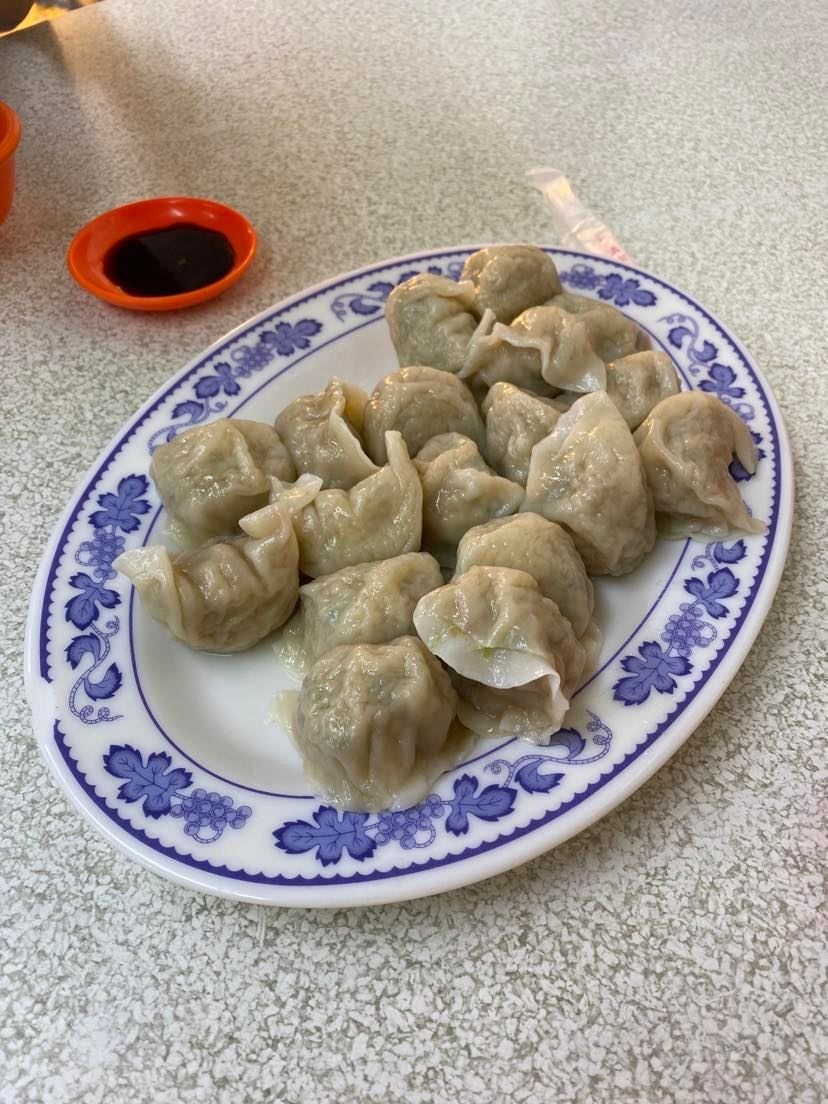
Jiaozi (猪肉白菜水饺) — Boiled Pork and Napa Cabbage Dumplings
Declassified 22 August 2026
Threat assessment
- 1 No contact Nobody is in danger. Least of all the locals.
- 2 Light resistance A warmth. You mention it. Nobody responds.
- 3 Engaged You are sweating. No one else at the table is sweating.
- 4 Taking fire You have stopped talking. A child has taken your portion.
- 5 Operative down Extraction required. Locals describe this one as "not spicy".
Jiaozi are the wheat-dough dumplings of northern China, Shandong and Beijing in particular, where they are both an ordinary weeknight dinner and the thing a whole family folds together on New Year's Eve. A good one is judged on three things: a wrapper rolled thick in the centre and thin at the rim so it survives the pot without turning doughy at the pleats, a filling whipped with seasoned water in one direction until it holds that liquid as soup, and a boil interrupted three times with cold water so the pork cooks through before the seams tear. Pork and napa cabbage is the default filling, the one against which every other is measured. Nothing here is technically hard, but rolling wrappers is a genuine skill and your first dozen will be worse than your last. Photo: Yeepunchmen (CC BY-SA 4.0), via Wikimedia Commons.
// SUPPLY LIST
SCALE:
| AMT | UNIT | ITEM |
|---|---|---|
| 3 | g | Sichuan peppercorns, whole |
| 150 | ml | Boiling water, for the peppercorn infusion |
| 500 | g | Plain flour, medium protein (10-11%), for the dough |
| 4 | g | Fine salt, for the dough |
| 250 | ml | Cold water, 15-18°C, for the dough |
| 600 | g | Napa cabbage, quartered, cored, shredded and then chopped to 3 mm dice by knife |
| 8 | g | Fine salt, for drawing water from the cabbage |
| 500 | g | Pork mince, coarsely ground, about 30% fat (shoulder with a piece of belly) |
| 15 | g | Fresh ginger, peeled and very finely minced |
| 60 | g | Spring onion, or Chinese large scallion (大葱), white parts only, very finely minced |
| 30 | ml | Light soy sauce |
| 15 | ml | Shaoxing rice wine |
| 2 | g | Ground white pepper |
| 3 | g | Caster sugar |
| 5 | g | Fine salt, for the filling |
| 20 | ml | Toasted sesame oil |
| 20 | g | Lard, melted and cooled, or a neutral oil |
| 60 | g | Plain flour, for dusting and for the resting tray |
| 450 | ml | Cold water, for the three additions to the pot (点三遍水), in 150 ml doses |
| 100 | ml | Chinkiang black vinegar |
| 4 | clove | Garlic, peeled |
| Chilli oil with sediment, to serve at the table |
// OPERATIONS
- 1 Make the peppercorn water first, before anything else, because it has to be stone cold before it meets the pork and 150 ml of just-boiled liquid does not get there in twenty minutes. Put the 3 g of Sichuan peppercorns in a heatproof cup, pour over the 150 ml of boiling water, and leave to steep for 30 minutes, by which point the water is the colour of weak tea and smells of citrus peel rather than of nothing at all. Strain out and discard the husks — you will be left with about 130 ml, the rest having soaked into the peppercorns — then stand the cup in the fridge at 4°C / 39°F, or in a bowl of iced water, until it is cold to the back of a finger with no warmth in it whatsoever, about 30 minutes more. This 花椒水 is the liquid the meat is whipped with, and it is there for fragrance and to strip the raw-pork smell, not to numb: warm liquid softens the fat in the mince so the filling will never take it up, and much more than 3 g of peppercorn tips a Shandong pork-and-cabbage filling from fragrant into tongue-buzzing, which is not what this dumpling tastes like.
- 2 Whisk the 500 g of flour with the 4 g of fine salt in a wide bowl, then add the 250 ml of cold water (15-18°C / 59-64°F) in three pours, cutting it through the flour with chopsticks after each until the bowl holds shaggy flakes and no dry powder is left in the base. Tip out onto an unfloured worktop and knead for 8 minutes into a firm, still slightly rough ball that dents rather than squashes under a thumb, then cover with a damp cloth and rest 30 minutes at room temperature (20-22°C / 68-72°F). This is a deliberately stiff 50% dough and it will fight you at first: use cold water, and add more only a teaspoon at a time and only if the flakes genuinely will not come together after a full minute of pressing — flours vary, but about 10 ml past the 250 ml is the outside limit. Warm water or a free hand with extra gives a slack wrapper that goes gummy at the pleats and splits at a rolling boil.
- 3 Chop the 600 g of napa cabbage by hand: quarter it, cut out the solid core, shred the leaves into 3 mm ribbons and then chop across into rough 3 mm dice. Do not use a food processor, which bruises the leaf to pulp and frees water you can never squeeze back out. Toss the cabbage with the 8 g of salt in a colander and leave 15 minutes, until the pieces have gone limp and glassy and a lightly squeezed handful runs wet, then take it up in handfuls and squeeze firmly over a bowl. You are after about 350 g of squeezed cabbage that still springs open slightly when you release your hand — wring it to a dry cork and the filling turns fibrous and mean, because the cabbage's whole job is to keep the pork juicy. Reserve 50 ml of the pale green juice and discard the rest.
- 4 Put the 500 g of pork mince in a large bowl with the 15 g of ginger, the 60 g of minced spring onion white, 30 ml of light soy, 15 ml of Shaoxing wine, 2 g of white pepper, 3 g of sugar and 5 g of salt, and stir with chopsticks or a sturdy spoon in ONE direction only — pick clockwise and never once reverse — for about a minute, until the loose crumbs pull together into a single tacky paste that travels round the bowl as one mass. The salt and soy have to go in now, before any water: salt is what dissolves the myosin out of the meat, and mince that has not been salted first will simply refuse to drink the liquid in the next step and will sit in a puddle instead.
- 5 Combine the cold peppercorn water (about 130 ml) with the reserved 50 ml of cabbage juice, giving roughly 180 ml, and beat it into the pork in four additions of about 45 ml, stirring 60-90 seconds in that same single direction after each and letting each addition vanish completely before the next goes in. After roughly 5 minutes the mass will be visibly paler, glossy and springy, and will climb the spoon in a standing ridge that holds for a second or two rather than sliding straight off — this is 上劲, and it is the whole point of the dish. Reversing direction, or tipping the liquid in all at once, unwinds the protein strands you are building and the filling will weep the moment it touches a wrapper.
- 6 In a separate bowl, toss the squeezed cabbage with the 20 ml of sesame oil and the 20 g of melted, cooled lard until every shred is glossed and the pile looks wet-shiny rather than merely damp. The fat goes onto the cabbage and not into the meat, and this is the order that matters: oil waterproofs the vegetable so it cannot leach into the meat while you wrap, which is the single reason home fillings turn to soup on the board. Now fold the oiled cabbage into the pork with a spatula in broad cutting strokes, 20-30 turns and no more, stopping while you can still see distinct flecks of white and green — pushing on past that shears apart the structure you just spent five minutes building. Cover and refrigerate at 4°C / 39°F for at least 20 minutes while you roll; cold, firm filling is far easier to wrap and should hold a scooped mound without slumping.
- 7 Knead the rested dough again for 3 minutes, until it is completely satin-smooth and leaves the worktop, your hands and the bowl all clean (面光、手光、盆光), then re-cover with the damp cloth and rest a second 30 minutes. Skip this second rest and the gluten stays tight: the wrappers will spring back and shrink faster than you can roll them, and you will finish with small thick ovals instead of thin round discs.
- 8 Cut the dough into 4 pieces, keeping three under the cloth. Roll the first under your palms into an even rope about 2.5 cm thick and 30 cm long, cut it into 15 pieces of roughly 12-13 g, then stand each piece cut-side up and press it flat with the heel of your palm into a 4 cm disc, dusting lightly from the 60 g of flour. Press them cut-side up rather than on their sides: the cut faces are where the dough's spirals meet, and pressing along that axis gives a disc that rolls out round instead of stubbornly oval. Work through the quarters as you reach them, keeping cut discs under the cloth so they do not skin over, and you should finish with about 60 discs.
- 9 Roll each disc with a short dumpling pin (about 30 cm long, 3 cm thick): press only from the rim to just past the centre and back in a short stroke, turning the disc roughly 60 degrees anticlockwise with the other hand between strokes, six strokes to a full turn, until you have an 8.5-9 cm round about 2 mm thick at the centre thinning to about 1 mm at the rim — held up to the light, the middle stays opaque while the rim glows through. Do not roll it flat and even like a tortilla: the thick centre is what stops the base blowing out in the pot, and the thin rim is what keeps the pleated seam from cooking into a doughy knot. Roll and fill in batches of 10-12 so the rounds do not dry out and refuse to seal.
- 10 Hold a wrapper flat on your cupped palm, place 18-20 g of filling (a rounded dessertspoon) in the centre, fold into a half-moon and pinch the seam shut at the top centre first, then work outwards to each corner with 4-5 pleats a side, pressing the pleated front edge onto the flat back edge and driving the air out ahead of your fingers — trapped air expands in the pot and pops the seam open. Fresh dough seals dry, so do not wet the edge, which only makes a slippery seam that opens in the water; wetting is for shop-bought wrappers, which have dried out. Stand each finished dumpling on a well-floured tray with a fat belly and a flat base, not touching its neighbours, and keep them under a cloth. If a little filling is left at the end, fry it as a small patty for the cook.
- 11 Bring 5 litres of water to a full rolling boil (100°C / 212°F) in a tall stockpot of at least 8 litres, about 24-26 cm across, over high heat, and slide in 20 dumplings, then immediately set the water turning in a slow circle with the back of a ladle — move the water, never push the dumplings, which tears the seams. Cover with the lid slightly ajar, because a covered pot of dumplings foams up fast and boils over the instant you turn your back, and when it returns to the boil and every dumpling has floated, 3-4 minutes, uncover and pour in 150 ml of cold water; the surface will drop off the boil to around 85°C / 185°F and the churning will stop dead.
- 12 Let it come back to a full boil and add 150 ml of cold water twice more, three additions in all (点三遍水), which takes about 10 minutes from the moment the dumplings went in. This staged cooling is not superstition and it is not skippable: the wrapper is cooked in about four minutes but the pork centre needs to reach 75°C / 167°F, and five more minutes of violent boiling will shake the seams open and empty the dumplings into the pot. They are ready when the bellies are round and taut, the skins have gone from chalky white to faintly translucent with the filling showing through as a grey-pink shadow, and one pressed with a fingertip springs straight back instead of denting; if you are unsure, lift one out and cut it — the pork should be uniformly pale with no pink and the juice should run clear.
- 13 Lift them out with a spider, draining 5 seconds over the pot, and cook the remaining two batches the same way, topping the pot back up to 5 litres with boiling water between batches so it returns to temperature quickly. While the first batch cooks, pound the 4 garlic cloves to a coarse paste in a mortar and stir it into the 100 ml of Chinkiang vinegar, then leave it 5 minutes for the raw edge to soften. Serve the dumplings the second they leave the pot — they are not a dish that rests, and the skins stiffen within five minutes — with the garlic vinegar and the chilli oil passed separately, and a small bowl of the cloudy cooking water for everyone to drink alongside (原汤化原食). Any dumplings you are not cooking go raw onto a floured tray in the freezer at -18°C / 0°F until solid, about 90 minutes, then into a bag; boil them straight from frozen, never thawed, with four cold-water additions and about 2 minutes longer.