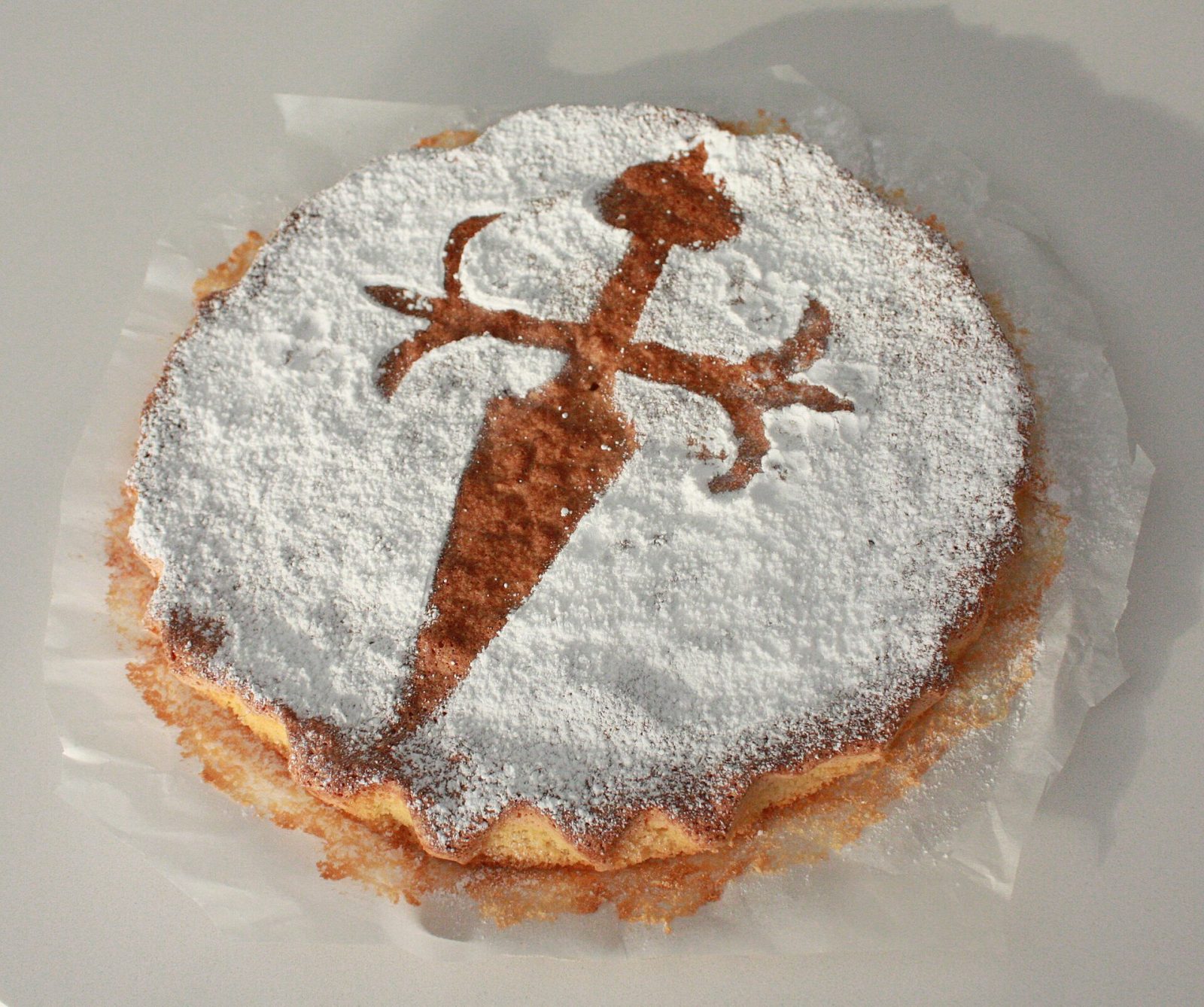
Tarta de Santiago (Saint James Almond Cake)
Declassified 22 August 2026
Threat assessment
- 1 No contact Nobody is in danger. Least of all the locals.
- 2 Light resistance A warmth. You mention it. Nobody responds.
- 3 Engaged You are sweating. No one else at the table is sweating.
- 4 Taking fire You have stopped talking. A child has taken your portion.
- 5 Operative down Extraction required. Locals describe this one as "not spicy".
Tarta de Santiago is Galicia's flourless almond cake — ground almonds, sugar, eggs and lemon zest, and essentially nothing else — baked around Santiago de Compostela since at least the sixteenth century and protected today by its own IGP, which sets a minimum of 33% almond by weight. A good one is moist and slightly coarse rather than fine and spongy, tastes overwhelmingly of almond with lemon just behind it, and keeps a thin, crisp, faintly crazed crust beneath its blanket of icing sugar. The Cruz de Santiago is not drawn in sugar but left bare: a solid card cross masks the cake while everything around it is dusted white. It has no flour, no butter and no raising agent, so all the lift comes from properly beaten eggs, and the only two real ways to wreck it are over-grinding the almonds and over-baking. Photo: Manel Zaera (CC BY-SA 2.0), via Wikimedia Commons.
// SUPPLY LIST
SCALE:
| AMT | UNIT | ITEM |
|---|---|---|
| 2 | tsp | Mild olive oil, for greasing the tin |
| 250 | g | Whole raw blanched almonds, skins removed, preferably Marcona or Largueta |
| 250 | g | Caster (superfine) sugar |
| 4 | Large eggs, at room temperature, weighed out of the shell (about 220 g total) | |
| 0.25 | tsp | Fine sea salt |
| 1 | Unwaxed lemon, zest finely grated, no white pith (about 2 tsp zest) | |
| 0.5 | tsp | Ground cinnamon |
| 1 | tbsp | Orujo blanco, aguardiente, sweet white wine or brandy |
| 3 | tbsp | Icing (confectioners') sugar, for dusting around the cross stencil |
// OPERATIONS
- 1 Take the eggs out of the fridge a full hour before you start and leave them on the worktop to reach room temperature, about 20C (68F): cold eggs whisk to barely half the volume of warm ones, and in a cake with no flour and no baking powder that volume is the entire leavening. Meanwhile heat the oven to 180C conventional / 160C fan (350F) with a shelf in the lower-middle position, and prepare a 24 cm (9 1/2 in) round loose-bottomed or springform tin in light-coloured metal: brush the base and sides with the olive oil and line the base with a disc of baking parchment. Galician home kitchens grease with butter and it works identically, but oil keeps the cake dairy-free as it should be; never flour or breadcrumb the tin, and avoid a dark non-stick tin, which scorches the base before the middle has set.
- 2 Pulse the blanched almonds in a food processor with 2 tablespoons taken from the weighed caster sugar, in short 2-second bursts, shaking the bowl between bursts, for 45-60 seconds of running time in total, until the meal has the texture of coarse semolina with a few pieces still the size of a match head. The sugar is there to soak up oil as the almonds break down, so do not leave it out; stop the instant the meal looks damp or begins clumping on the blade, because ten seconds more turns it to almond butter and the cake bakes greasy and squat. Shop-bought ground almonds are used all over Galicia and are a fair shortcut, but buy blanched almond meal rather than ultra-fine almond flour, which gives a pasty, close crumb.
- 3 Whisk the room-temperature eggs, the remaining sugar and the salt in a large bowl with an electric whisk on high for a full 5 minutes, until the mixture is pale ivory, roughly doubled in volume, and a ribbon drizzled from the beaters sits on the surface for about 3 seconds before sinking. If the ribbon vanishes on contact the foam is not there yet — keep going another minute rather than pressing on. Those beaten eggs are the entire leavening, since there is no flour, no baking powder and no bicarbonate in a real tarta de Santiago, so cutting this short is exactly what produces the flat, damp, heavy version people complain about.
- 4 Whisk in the lemon zest, cinnamon and orujo on the lowest speed for 10 seconds, just enough to distribute them evenly and no longer, as the spirit is liquid and will slacken the foam if you beat it in hard. Keep to these quantities: lemon should read as the clear second flavour after almond and cinnamon only as background warmth, and a heaped teaspoon of cinnamon or a bigger splash of spirit pushes the cake into generic almond sponge and out of Galicia.
- 5 Tip a third of the ground almonds over the egg foam and fold with a large flexible spatula — cut down through the centre, sweep along the bottom and up the side, turn the bowl a quarter turn, repeat — then fold in the second and third additions the same way, stopping the moment no dry almond is visible, about 25 strokes in all. The batter should be thick, glossy and reluctant to drop off the spatula; if it starts to look loose and pourable you have already knocked the air out, and stirring or beating at this stage collapses everything you spent five minutes building.
- 6 Scrape the batter into the prepared tin and level the top gently with an offset spatula so it sits about 2.5 cm (1 in) deep, easing it out to the edges rather than spreading it back and forth. Do not rap or drop the tin on the worktop to settle it, however often you have seen that done with other cakes — here the bubbles you would knock out are the only rise there is. Bake on the lower-middle shelf at 180C conventional / 160C fan (350F) for 35-40 minutes, until the top is an even deep golden brown, dry and faintly crazed, the cake has just begun to shrink from the sides of the tin, and a skewer pushed into the centre comes out with a few moist crumbs clinging to it; a bone-dry skewer means roughly five minutes too long, and with no fat but almond oil in the crumb there is nothing to disguise it. If the top is colouring hard before the 30-minute mark, lay a sheet of foil loosely over it and carry on.
- 7 Set the tin on a wire rack and leave the cake completely undisturbed for 15 minutes — it is fragile while hot and will crack straight across if you move it now — then run a thin knife around the edge and release the ring, but leave the cake sitting on the tin base. Let it cool there until stone cold, at least 2 hours, and only then slide a palette knife underneath, lift it onto the rack and peel the parchment from the bottom. Keep the baked side uppermost throughout: that thin crazed crust is the surface the sugar sits on, so never invert the cake to flatten it.
- 8 If you have the time, leave the undusted cake overnight at room temperature under an upturned bowl before decorating: the crumb settles, the almond oil redistributes and the flavour is noticeably deeper and rounder the next day. Do not refrigerate it at any point — the fridge dries the crumb and makes the surface bead with moisture that will later dissolve the sugar into grey streaks.
- 9 Cut the Cruz de Santiago from stiff paper or thin card: for a 24 cm cake, draw a cross about 18 cm tall and 12 cm across, with the lower arm shaped as a long sword blade tapering to a point and the other three arms flaring into fleur-de-lis heads. Cut out the cross itself as one solid piece and keep that piece — it is a mask, not a frame. The finished tarta is a white field with the cross showing through in bare golden cake, so cutting a cross-shaped hole in a sheet of card gives you the design in reverse and is the mistake to avoid.
- 10 Lay the card cross flat and centred on the completely cold cake and sift the icing sugar over the whole surface from about 25 cm above, working in two or three even passes until every bit of exposed cake is opaque white, then brush the loose sugar sitting on the card inwards towards the middle and lift the stencil straight up and away without dragging it sideways. The cake must be stone cold: dust it even faintly warm and within minutes the sugar melts into translucent grey blotches, which is the single most common way a good tarta is ruined at the last moment.
- 11 Dust no more than an hour or two before serving, then cut into slim wedges with a long thin knife wiped clean between slices, and serve at room temperature with a small glass of chilled orujo or a sweet Galician tostado, or with strong black coffee. It keeps well for 4-5 days covered at room temperature, and it is served plain in Galicia — no cream, no ice cream, no sauce — because a cake that is one-third almond needs none.