Spanish Potato Omelette (Tortilla de Patatas)
Declassified 22 August 2026
Threat assessment
- 1 No contact Nobody is in danger. Least of all the locals.
- 2 Light resistance A warmth. You mention it. Nobody responds.
- 3 Engaged You are sweating. No one else at the table is sweating.
- 4 Taking fire You have stopped talking. A child has taken your portion.
- 5 Operative down Extraction required. Locals describe this one as "not spicy".
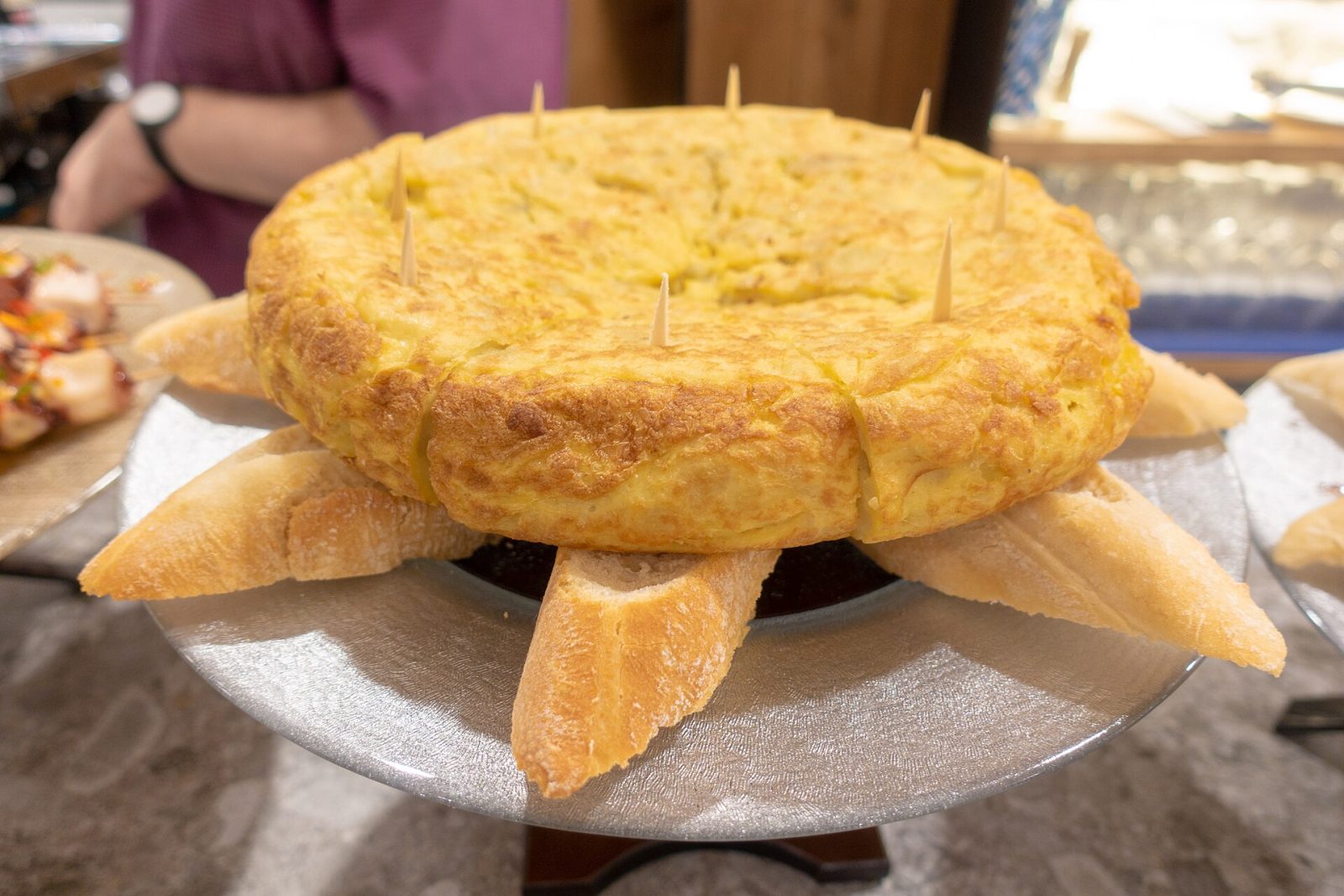
Tortilla de patatas is Spain's national omelette: a thick, deep cake of egg and potato, usually with onion, bound by the potatoes' own starch and nothing else — no flour, no milk, no cheese. The potatoes are cooked slowly in a deep bath of olive oil, confit rather than crisped, until a slice collapses to paste under light spoon pressure; let them brown and the finished tortilla tastes of crisps instead of potato. A good one is deep gold outside and pale, barely set and creamy inside (jugosa), with onion that tastes sweet and blond rather than caramelised. It is eaten warm or at room temperature — as a tapa, a picnic slab, or supper with bread — and never straight from the fridge. Photo: Kent Wang (CC BY-SA 2.0), via Wikimedia Commons.
// SUPPLY LIST
SCALE:
| AMT | UNIT | ITEM |
|---|---|---|
| 800 | g | Medium-starch all-purpose potatoes (Monalisa, Kennebec, Agria or Yukon Gold), peeled weight, sliced 3 mm thick and each slice halved — not waxy salad potatoes, which stay firm and will not crush to paste |
| 250 | g | Onion, yellow or white, peeled, halved and sliced 3 mm thick |
| 700 | ml | Mild extra virgin olive oil (arbequina or a soft blend), for poaching the potato — strained and reused afterwards |
| 8 | g | Fine sea salt, for salting the hot drained potato and onion |
| 8 | Large eggs, at room temperature (about 480 g out of shell) | |
| 4 | g | Fine sea salt, for the beaten eggs |
| 2.5 | tbsp | Reserved poaching oil, for the frying pan (2 tbsp for the first side, 1 tsp for the second) |
| Crusty bread, to serve |
// OPERATIONS
- 1 Take the 8 eggs out of the fridge now so they come to room temperature while you work — cold eggs chill the potato mixture and drag out the set in the pan. Peel 800 g potatoes and cut them into slices a scant 3 mm (1/8 in) thick, then halve each slice so the pieces stack flat against one another in the finished cake. Do not rinse or soak the cut potato: the surface starch is the only binder this recipe has, and washing it away gives a loose tortilla that weeps liquid the moment you cut it. Hold the cut potato dry in a bowl.
- 2 Pour 700 ml mild extra virgin olive oil into a deep 24 cm (9.5 in) saucepan or sauté pan and bring it to 130 C (266 F) over medium heat — a test slice should sizzle lazily around its edge, not fizz hard. Slide in all the potato; the oil should just cover it. Use the full quantity even though it looks extravagant: this is a confit, and you strain and reuse the oil afterwards. Adding 800 g of cold potato will crash the oil by 20-30 C, so nudge the heat up for a minute or two until it settles back into range rather than letting it stew below temperature.
- 3 Poach the potato at 130-140 C (266-284 F), stirring gently every 5 minutes with a slotted spoon, for 10 minutes. Add the 250 g sliced onion and continue for a further 15-20 minutes, 25-30 minutes in total, until a slice crushes to a smooth paste against the side of the pan under light spoon pressure and the onion is translucent and blond. Adjust the heat so nothing colours past pale gold — any browning means you are frying rather than poaching, and the tortilla will taste of crisps instead of potato.
- 4 Tip everything into a colander set over a heatproof bowl and leave to drain for 3-4 minutes, shaking once. Scatter the 8 g fine salt over the hot potato and onion and turn once, gently — hot potato takes up salt far better than cold egg does, and salting only the eggs leaves the potato bland at the centre of every slice. Reserve the drained oil; once cool, strain it and keep it for the next tortilla or for frying.
- 5 While the potato drains, beat the 8 room-temperature eggs with the 4 g salt in a large bowl using a fork for about 30 seconds, until yolk and white are one uniform colour with no ropes of white left. Stop the moment it looks homogeneous: beaten-in air makes the tortilla puff like a soufflé in the pan and then collapse into a dry, spongy disc.
- 6 Tip the warm — not scalding — potato and onion into the eggs and fold with a spatula, deliberately crushing about a third of the slices to thicken the mixture; if it is still steaming heavily it will scramble the egg on contact, so give it another minute in the colander first. Rest the mixture at room temperature for 15 minutes, folding once halfway through. This reposo is not skippable: the starch and egg swell into each other and set as one creamy mass, and without it you get scrambled eggs with potato in them.
- 7 Set a 24 cm (9.5 in) nonstick or well-seasoned carbon steel frying pan with sloping sides over medium-high heat, add 2 tbsp of the reserved oil and swirl to coat the sides as well as the base. Heat until a drop of the egg mixture sets on contact with an audible hiss, roughly 180-190 C (355-375 F) — a cool pan is the single most common cause of a tortilla that welds itself down and tears at the flip.
- 8 Pour the mixture in all at once and level the top. For the first 20 seconds stir briskly with a flat spatula, sweeping the setting edges into the centre to build curd; then stop, drop the heat to medium-low and cook undisturbed for 3 minutes for jugosa (4-5 minutes for a fully set cuajada), running the spatula around the rim and pushing inward to round the sides. Shake the pan every 30 seconds — the whole cake must slide freely as one piece before you dare flip it.
- 9 Flip it. Tilt the pan and pour off any loose oil first, then take a flat plate or lid wider than the pan (about 28 cm), press it firmly over the top and hold it through a dry cloth or oven glove, because it will be hot. Lift the pan off the heat, put one flat palm on the plate and invert in one decisive motion over the sink, keeping plate and pan clamped together. Hesitating mid-turn is the only way this goes wrong; commit and it will not.
- 10 Return the pan to medium-low heat, add the last 1 tsp of reserved oil, and slide the tortilla back in raw side down. Immediately tuck the spatula around the edge and push inward all the way round to build the cushion shape, then cook 2-3 minutes for jugosa or 4 minutes for cuajada. Press the centre with a fingertip: jugosa feels like a firm marshmallow with a distinct give, cuajada springs straight back.
- 11 If you want an even colour, flip once more and give each side a final 30 seconds. Slide the tortilla onto a wooden board or plate and rest it for at least 5-10 minutes before cutting — cut it hot and the just-set centre runs out across the board; rested, it firms into a sliceable, creamy curd.
- 12 Serve in wedges, warm or at room temperature, with crusty bread and perhaps olives, a chilled fino or a caña. Leftovers keep 2 days covered in the fridge, but bring them fully back to room temperature before eating — cold tortilla is a different, worse dish. On alioli: it is common in bars, and a Castilian grandmother will tell you a good tortilla does not need it. She is right, but nobody will stop you.